
Reviewed · MUNICH THIRD REICH & WWII TOURS
Walking Tour on Origins of Nazism in Munich – English
Munich’s Nazi past is not tucked away in one museum. It is written into the city center, from the memorial square at the start to the grand buildings and political plazas at the finish. This two-hour English walking tour connects those places into one clear story, following the rise of Hitler’s movement in the city where it first gained power.
I like the route for two reasons: it links political events to actual streets and buildings, and it includes both Nazi sites and memorials to victims and resistance. The main caution is time. Nazism is a huge subject, and two hours can only provide an introduction. Plan to visit a museum afterward if you want documents, photographs, and more detail.
- Munich’s Nazi story in one central walking route: Follow the path from Marienplatz to Königsplatz through key political and propaganda sites.
- A useful mix of places: See the Hofbräuhaus, Haus der Kunst, Hofgarten, Odeonsplatz, and monuments to victims and resistance.
- A guide-led history lesson: An expert English-speaking guide explains events that can be hard to understand from buildings alone.
- A 3 pm start: The afternoon departure fits well after a morning museum visit or a relaxed lunch.
- A small but not tiny group: The tour allows up to 35 people, so the guide can address questions, though the walk may not feel intimate.
- Good value at $20.16: You pay for the guide and a focused route, while lunch and museum admissions are not included.
Why Munich is the right place to study the Nazi rise
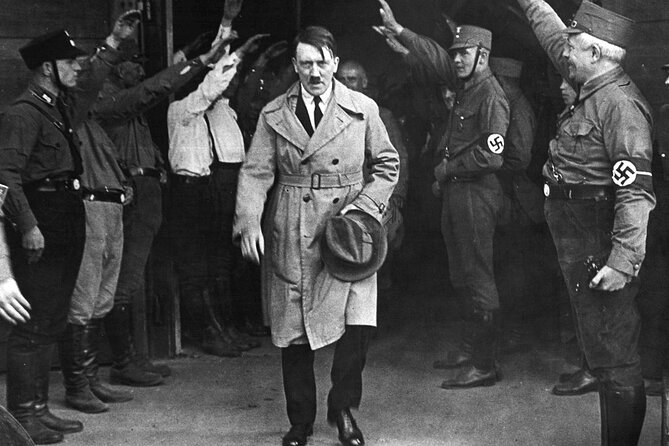
Adolf Hitler arrived in Munich as a young soldier after the First World War. He was sent to watch the German Workers’ Party, but instead joined it, took control of its message, and helped turn it into the National Socialist German Workers’ Party.
That change did not happen in an abstract political world. It happened in meeting halls, beer halls, government spaces, parks, and grand public squares. This is what makes the walk useful: you see how ordinary city places became linked to propaganda, political violence, and state power.
The tour also covers events beyond the party’s early years. You hear about Hitler’s failed coup attempt, the burning of books associated with Nazi repression, and Kristallnacht, the night of broken glass. These subjects can feel disconnected when studied from a page. On foot, the route gives them a physical setting.
I appreciate that the walk is not presented only as a story of Nazi leaders. The route also points to memorials for victims and to resistance movements. That balance matters in Munich, where the city has had to confront both its role in the Nazi rise and the people who opposed it.
Starting at the Mariensäule and the victims’ memorial
Meet at the Mariensäule in Marienplatz at 3 pm. The column is easy to locate in Munich’s central square, and the meeting point is close to public transportation.
The first planned stop is Platz der Opfer des Nationalsozialismus, or Square of the Victims of National Socialism. You spend about 15 minutes here. It is a short stop, but an important one because it places victims at the front of the story rather than treating them as an afterthought.
This opening helps set the tone. The tour is not meant to celebrate the machinery of Nazi power. It examines how that power grew, what it did, and how Munich remembers those who suffered under it.
You should arrive a little early so you can find the Mariensäule without rushing. The mobile ticket is useful, but the tour details still depend on being at the correct central meeting point at the stated time.
Other Third Reich and wartime history tours in Munich:
- Munich: Third Reich & WWII Walking Tour
★ 4.6 · 6,181 reviews - Third Reich Walking Tour Munich
★ 4.5 · 4,291 reviews - Munich: Birthplace of the Third Reich Guided Walking Tour
★ 4.6 · 771 reviews
Hofbräuhaus and the beer-hall politics of early Nazism
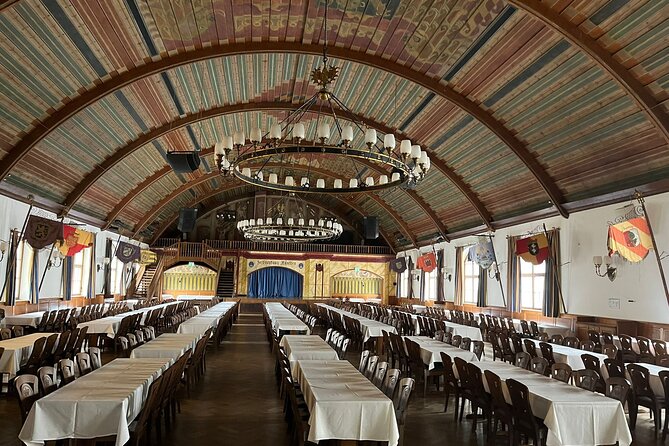
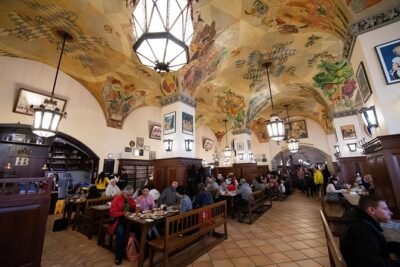
The walk continues to Staatliches Hofbräuhaus, described as the place where the Nazi party established its base. You spend about 15 minutes here.
This stop gives the political story a distinctly Munich setting. Beer halls were not simply places for food and drink. They could also serve as meeting places where speeches, arguments, and political organizing reached a broad audience.
The site helps explain how the party presented itself before it became the government of Germany. Hitler and his allies used public gatherings to attract attention, build loyalty, and turn anger after the First World War into political support.
You should not expect a long indoor visit or a meal as part of the tour. Lunch is not included, and the experience is designed as an outdoor walking route with an expert guide. If you want to eat at the Hofbräuhaus, plan that separately before or after the tour rather than counting on time during the visit.
Haus der Kunst and architecture used as propaganda
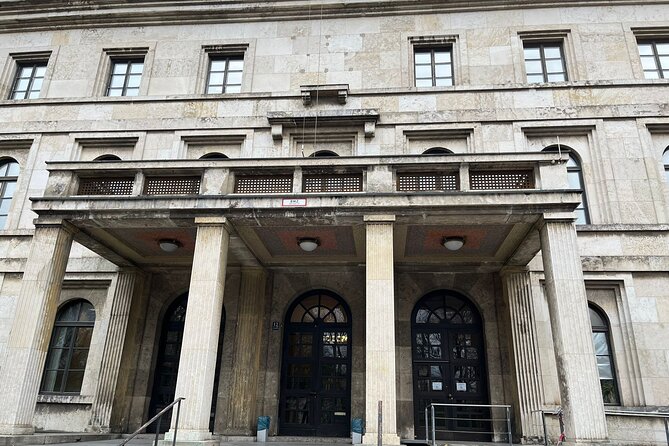
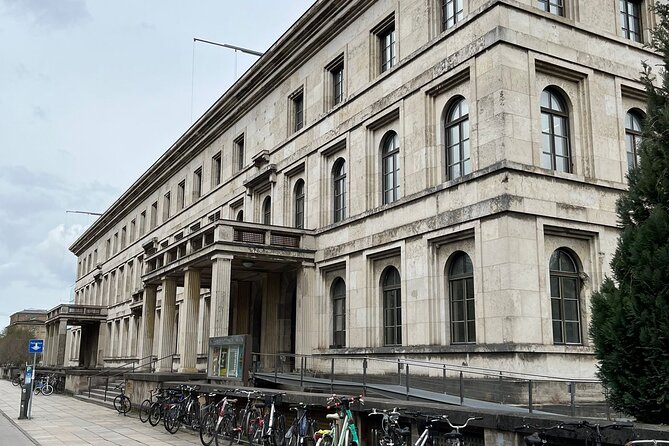
At Haus der Kunst, the guide spends roughly 15 minutes explaining the building’s role as an early propaganda project of the Third Reich. Today it functions as a museum, but its original political purpose is central to the stop.
This is one of the more useful places on the route because it shows how architecture can carry an ideology. Large public buildings can project order, strength, and authority before anyone enters them. In the Nazi period, cultural buildings were also used to define which art and ideas the state approved.
The stop is brief, so you will likely leave with the building’s political meaning rather than a full study of its design or collections. That is not a flaw, but it is worth knowing. If you are interested in art policy, propaganda, or the cultural rules imposed by the Third Reich, set aside extra time for a museum visit on another day.
The route’s best feature is this connection between structure and politics. You are not only hearing what the Nazis believed. You are seeing how those beliefs were made visible in public space.
Hofgarten and the memory of resistance
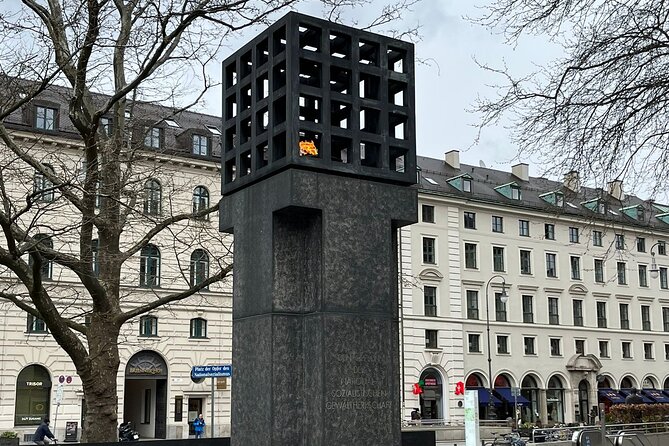
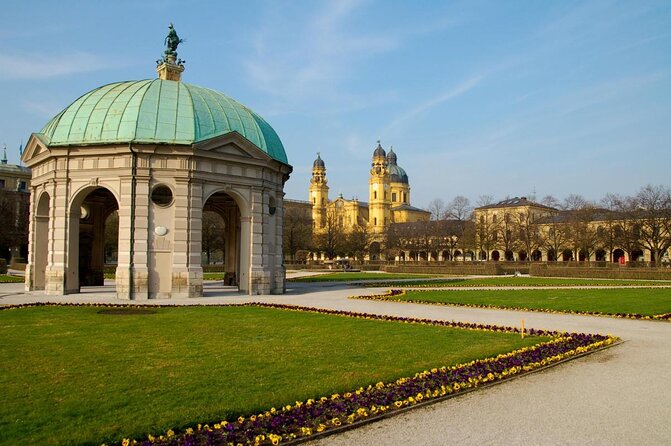
The next stop is Hofgarten, one of Munich’s major parks, with about 20 minutes devoted to the area. The park offers a change of pace after the political buildings and formal squares.
Here, the focus includes resistance and the difficult question of how ordinary people responded to dictatorship. The route does not treat the Nazi period as a smooth march from early party meetings to total control. It also recognizes opposition and the danger faced by people who rejected the regime.
A park can seem like an unexpected place for a history tour, but that is part of its value. Nazi history is not confined to official headquarters. Public spaces could become places of protest, surveillance, memory, and later reflection.
The extra time here may also help the group stay together and handle questions. The tour allows up to 35 people, so the guide may need to position the group carefully in busy areas. A larger group can make it harder to hear, especially if you stand at the back, so moving closer when the guide gathers everyone is sensible.
More walks through the old town:
- Munich: Old Town & Viktualienmarkt City Walk in German
★ 4.7 · 2,304 reviews - Munich: Night Watchman Walking Tour
★ 4.7 · 2,092 reviews - Munich Ghosts and Spirits Evening Walking Tour
★ 5.0 · 1,900 reviews - Munich Old Town Walking Tour
★ 4.5 · 1,287 reviews
Odeonsplatz and Hitler’s failed coup
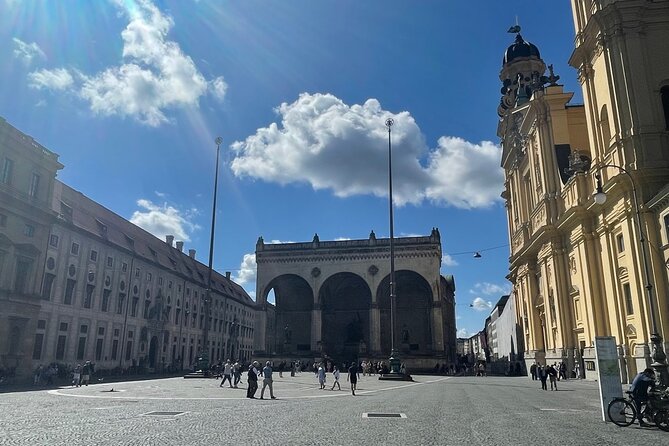
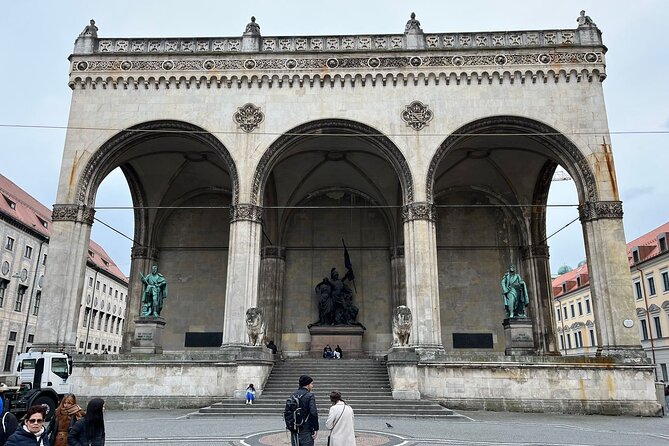
Odeonsplatz receives about 15 minutes. This is one of Munich’s key squares and an important setting for the story of Hitler’s failed coup attempt.
The failed putsch is a turning point. It showed that the Nazi movement could not simply seize power through a quick act of force. Afterward, Hitler changed tactics and pursued power through a longer political campaign.
That distinction is worth understanding. The movement’s eventual success was not based on one dramatic march alone. It involved speeches, organization, propaganda, elections, intimidation, and the exploitation of public fear and resentment.
The guide’s explanation is especially valuable here because a square can look completely ordinary without context. You may otherwise pass through Odeonsplatz and see only a handsome city space. The tour asks you to read it as a place where political conflict once played out in public.
Königsplatz and the Third Reich’s planned city
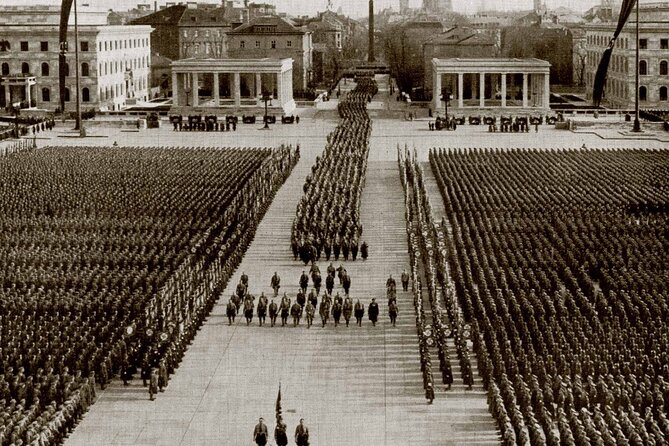
The final stop is Königsplatz, about 15 minutes from the scheduled route. The tour ends at Königsplatz 1, giving you a clear finish rather than returning you to Marienplatz.
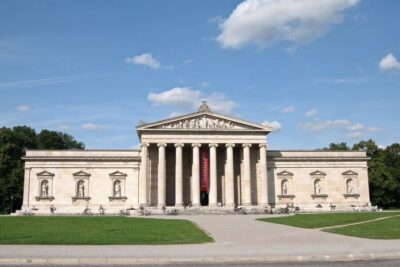
Königsplatz was one of the main squares that formed the backbone of the city redesigned by the Third Reich. The scale and arrangement of the area helped project the authority and grandeur the regime wanted to associate with itself.
This is a strong ending because the route moves from early party organizing to the public face of state power. You can see how the Nazis used urban design to make their presence feel permanent and overwhelming.
The end point also works well for extending your afternoon. You can stop there to reflect on the walk, continue exploring central Munich, or visit another site on your own. The tour does not include lunch or museum entry, so you remain free to choose what comes next.
What the guide adds to the buildings
The buildings and squares are worthwhile, but the guide is the main reason to book this experience rather than simply following a map. The listed inclusion is an expert guide, and the route covers a subject where dates and names alone are not enough.
You need help connecting the stages: Hitler’s arrival in Munich, his contact with the German Workers’ Party, the party’s reorganization, the failed coup, propaganda, persecution, and the destruction that followed. A guide can also explain the difference between Nazi party sites, later memorials, and places that have changed function.
One published rating for the experience is 4.4 out of 5 from 19 reviews. The written feedback specifically praised the guide and described the walk as a very good introduction, while also noting that the subject is so broad that the two-hour duration can feel short. That is the fairest way to judge the experience: useful as a starting point, not a complete course on the Third Reich.
No guide’s name is provided, so you should not book expecting a particular individual. The tour is offered in English, and the guide is responsible for making a complex and sensitive subject understandable to an international audience.
Is $20.16 a fair price?
At $20.16 per person, this is a reasonable price for a two-hour guided walk in central Munich. You are paying for structure and explanation rather than admission to a large museum or a special interior access program.
The value is strongest if you are new to Munich’s Nazi history. The guide connects six stops that would otherwise feel scattered, and you gain a working outline for later museum visits.
The price is less attractive if you already know the subject well or prefer to read at your own pace. You will not receive lunch, and museum admissions are not included. The route is also limited to about two hours, so the cost is really for orientation and interpretation.
For many people, that is exactly the right use of $20.16. A focused introduction can prevent you from wandering between sites without understanding how they fit together.
Timing, group size, and walking comfort
The 3 pm start leaves your morning open. You could spend the first part of the day in another Munich museum, explore Marienplatz, or simply have a relaxed lunch before meeting at the Mariensäule.
The full duration is approximately two hours. Since the experience is a walking tour through central Munich, wear shoes suited to city streets and expect to remain with the group for most of the afternoon. Specific walking distances are not provided, so anyone with concerns about stamina should ask the provider before booking.
The maximum group size is 35 people. That is not a private tour, but it is still small enough for a single guide to lead the route. If you want a highly personal discussion with lots of individual attention, this may feel too large. If you prefer the security and lower cost of a group tour, the size is reasonable.
Most people can participate, and the route is near public transportation. Confirmation arrives when you book, and the mobile ticket makes it simple to keep the reservation on your phone.
How to build a fuller Munich history day
The best way to use this walk is as the middle part of a larger day. Before 3 pm, you can visit central Munich or read a short background account of the Weimar period and Hitler’s early political career.
After the tour, follow up with a museum or memorial. The walk itself introduces the subjects, but it cannot provide every document, photograph, personal account, or political detail in two hours. The written feedback makes this point clearly: the tour works best when you complement it with museums and additional visits.
Give yourself room to think afterward. The route covers the book burning, Kristallnacht, the failed coup, party organizing, propaganda, resistance, and victims of war. That is a heavy amount of material for one afternoon, even when the walk is well paced.
Free cancellation is available if you cancel at least 24 hours before the 3 pm start time. Changes made within that final 24-hour period are not accepted, and a minimum number of participants is required. If the provider cancels because that minimum is not met, you are offered another date or experience, or a full refund.
Should you book this Munich walking tour?
Book it if you want a clear first look at how Munich became central to the Nazi movement. The route is well chosen, the price is modest, and the combination of political sites, propaganda architecture, resistance, and memorials gives you more than a simple list of famous addresses.
I would especially recommend it for first-time visitors, history students, and anyone who wants a human guide before tackling museums on their own. The English format and central meeting points make it easy to add to a Munich itinerary.
Skip it if you want extensive museum time, private guiding, or a narrow specialist study of one topic. Two hours cannot answer every question about Nazism, and the group may include up to 35 people.
For most visitors, I would book the walk and treat it as an introduction. Come ready to listen, ask questions, and continue the subject afterward. That is where this experience has the most value.
FAQ
Where does the tour start?
The tour starts at the Mariensäule, Marienplatz 22, 80331 München, Germany.
What time does the tour begin?
The scheduled start time is 3 pm.
Where does the tour end?
The tour ends at Königsplatz 1, 80333 München, Germany.
How long does the walking tour last?
The tour lasts approximately two hours.
Is the tour conducted in English?
Yes. This experience is the English version of the Munich walking tour.
What is the price?
The listed price is $20.16 per person.
What is included?
An expert guide is included.
Is lunch included?
No. Lunch is not included in the tour price.
Are museum admissions included?
The supplied tour details do not list museum admission as an included feature. The experience is described as a guided walking route through the city.
How many people can join the tour?
The tour has a maximum group size of 35 people.
Can I cancel for a full refund?
Yes, if you cancel at least 24 hours before the experience start time. Cancellations made less than 24 hours in advance are not refunded.
Recently reviewed in Munich
- München: Vegetarische Viktualienmarkt-Probiertour Deutsch★ 4.8 · 6 reviews
- Wright Europe Vacations – Private Escorted Auto Tours★ 5.0 · 35 reviews
- Best of Munich Electric Bike Tour★ 5.0 · 38 reviews
- Munich Walking Quiz: Explore and Discover the City’s Highlights★ 5.0 · 7 reviews
- Walking Tour on Resistance to Nazism in Munich★ 5.0 · 8 reviews
- Private Transfer from Munich to Vienna with 2 hours for sightseeing★ 4.5 · 6 reviews
- Private Transfer from Munich to Salzburg with 2 hours for sightseeing★ 4.5 · 13 reviews
- 2 hour Sights Guided E-Scooter Tour in Munich★ 4.0 · 6 reviews
Munich Third Reich & WWII Tours, compared.
Birthplace of the Third Reich Guided Walking Tour
Read our review →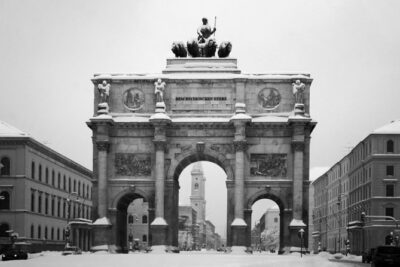
Munich World War II Sites Including Dachau Concentration Camp
Read our review →
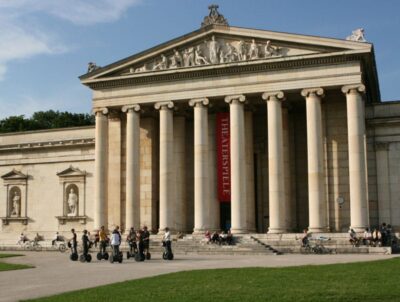
Munich 3-Hour Segway Tour: Nazi Munich & Royal Architecture
Read our review →
Dachau Concentration Camp Memorial Site And Third Reich Day Tour From Munich
Read our review →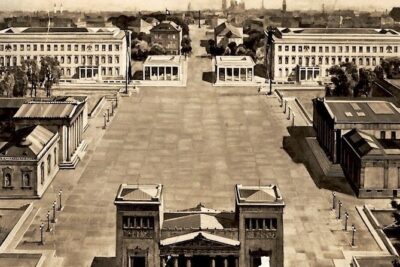
Browse the lists this tour appears in