
Reviewed · MUNICH THIRD REICH & WWII TOURS
Walking Tour on Resistance to Nazism in Munich
Munich’s Nazi past is easiest to understand when you follow the people who refused to accept it. This 2.5-hour walking tour links royal politics, military opposition, censored art, religious protest, the White Rose, and Georg Elser across central Munich.
I like the clear route from Odeonsplatz to Georg-Elser-Platz, and I like that the tour gives attention to several kinds of resistance rather than focusing only on the White Rose. The main thing to consider is the subject itself: this is serious material, and the steady pace across eight stops may feel demanding if you prefer a slower sightseeing walk.
Key points at a glance
- Eight central Munich stops: The route runs from Hofgarten through the Bavarian State Chancellery area, Prinzregentenstraße, Ludwigskirche, and Maxvorstadt.
- Resistance from many sides: You’ll hear about political parties, military officers, artists, clergy, students, and an individual plotter.
- The White Rose gets its own stop: The DenkStätte Weiße Rose provides the clearest focus on Munich’s best-known resistance group.
- Guides shape the experience: Laura, Maca, Javier, Jaime, and Julieta have all led this tour, with particular praise for clear, engaging explanations.
- A useful price for a focused history walk: At $19.49 per person, you pay less than many large museum visits while getting a guided route through the city.
- Plan for a moving outdoor class: Admission is free at every stop, but you’ll spend most of the time walking and listening outside.
Why Munich’s resistance story works as a walking tour
This experience does not treat the Nazi period as a distant chapter sealed inside a museum. It places the discussion at government buildings, churches, monuments, and streets where the political story becomes easier to follow.
You begin with the royal family and the political situation at Hofgarten. From there, the route widens. Political opposition leads to military resistance, then to art and press control, church policy, student protest, and finally the efforts of Georg Elser.
That sequence matters. It shows that resistance was not one single movement with one shared plan. People opposed the regime for different reasons and in different ways. Some defended political freedom. Some rejected censorship. Some opposed specific policies. Others acted against Hitler himself.
I also appreciate the tour’s use of ordinary city streets. You are not simply handed dates and names in a classroom. You move from place to place, and each stop gives the guide a fresh setting for the next part of the story. The route turns Munich into a map of difficult choices.
The format is best for someone who wants interpretation rather than private sightseeing time. At each stop, you will usually spend about 20 minutes listening and discussing before moving on. The total duration is approximately two hours and 30 minutes, including the walking between locations.
Other Third Reich and wartime history tours in Munich:
- Munich: Third Reich & WWII Walking Tour
★ 4.6 · 6,181 reviews - Third Reich Walking Tour Munich
★ 4.5 · 4,291 reviews - Munich: Birthplace of the Third Reich Guided Walking Tour
★ 4.6 · 771 reviews
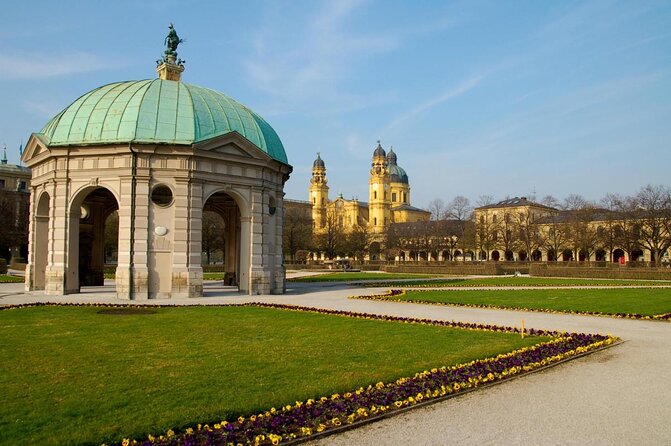
Hofgarten begins with royal life and political change
The first stop is Hofgarten, near the 3:00 pm meeting point at Odeonsplatz. Here the guide explains how the royal family lived during the Nazi period and sets out the political situation of the time.
This is a useful opening because it gives you a wider frame before the tour turns to individual acts of resistance. You start by considering how daily life and public power changed when the Nazi regime took control.
The stop is also practical. Odeonsplatz is near public transportation, so it is a straightforward place to reach. You do not need to enter a paid attraction at the beginning, and the visit is outdoors.
Expect the guide to establish names, institutions, and political background here. If you arrive early, use that time to find the meeting point and settle in. The tour begins at 3:00 pm, and a mobile ticket is accepted.
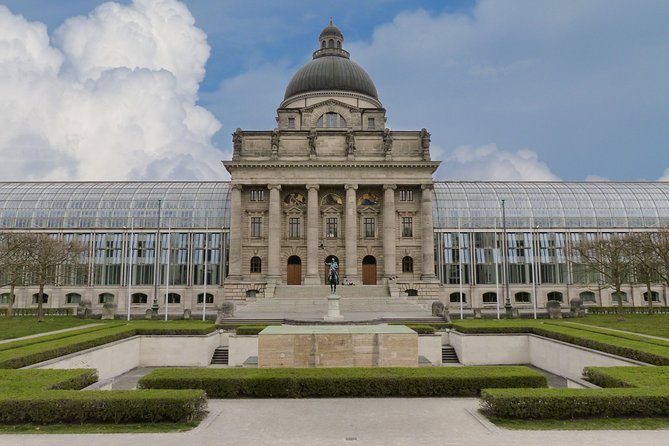
The Bavarian State Chancellery and political opposition
At the Bavarian State Chancellery, the focus shifts to political parties that resisted the regime and to Sopade. This part helps correct the idea that resistance began only with famous individual figures.
The political story can be harder to grasp than a memorial or a dramatic assassination plot. A good guide has to explain who opposed the regime, how political organization changed, and what opposition looked like once normal public debate was crushed.
This is where guide quality matters most. Laura is repeatedly singled out for friendly, clear explanations, while Maca is praised for presenting the subject with detail and strong feeling. The tour has also been led by Javier, Jaime, and Julieta, so your exact experience will depend on the assigned guide.
You should feel free to ask questions here. The tour is designed around explanation rather than a quick photo stop, and the guides are described as willing to answer questions and make the material easy to follow.
Prinzregentenstraße and resistance inside the military
The third stop takes you to Prinzregentenstraße and the building of the former Luftwaffe Command Center. The discussion turns to resistance within the military itself.
This is an important change of angle. Military opposition raises complicated questions about duty, obedience, political loyalty, and the moment when an officer decides that following orders is no longer acceptable.
The setting helps you think about resistance within institutions, not just resistance from outsiders. The tour does not present opposition as a simple division between good people and bad people. Instead, it points you toward the choices made by people who were part of the system and later opposed it.
The stop is planned for about 20 minutes. You will need to remain attentive while standing outdoors, so comfortable shoes and weather-appropriate clothing make sense. The route is not presented as a strenuous hike, and most people can participate, but it is still a continuous walking experience.
More walks through the old town:
- Munich: Old Town & Viktualienmarkt City Walk in German
★ 4.7 · 2,304 reviews - Munich: Night Watchman Walking Tour
★ 4.7 · 2,092 reviews - Munich Ghosts and Spirits Evening Walking Tour
★ 5.0 · 1,900 reviews - Munich Old Town Walking Tour
★ 4.5 · 1,287 reviews
Valkyrie at the Bavarian National Museum
At the Bavarian National Museum, the guide explains what happened in Operation Valkyrie. This gives the tour one of its clearest looks at organized military resistance.
The stop works well after the Luftwaffe discussion because you have already heard about opposition within the armed forces. The guide can then place Valkyrie within the larger question of how resistance moved from private doubt to an attempt to change political power.
You should expect a serious explanation rather than a theatrical reenactment. No museum admission is included or needed for the stop, since the tour uses the location as a point for discussion. That keeps the price low, but it also means you should not expect an indoor exhibition here.
The Bavarian National Museum is roughly midway through the route. If you need a break, this is a good point to check how you are feeling. The group continues through several more stops, and there is no indication of a long formal pause.
Haus der Kunst and the Nazi attack on artistic freedom
At Haus der Kunst, the topic changes from political plots to cultural control. You will learn how the Nazi regime tried to censor art, including the exhibition of Degenerate Art, and how propaganda shaped the press.
This is one of the tour’s most valuable contrasts. Resistance is not limited to secret meetings or attempts to overthrow the government. Control of art, news, and public discussion also formed part of the regime’s power.
The guide connects the building and the surrounding area with the way the regime managed public messages. That makes the stop useful even if you have little background in modern art. The central issue is simple: who decides what people may see, read, and believe?
The subject can become broad, so clear guiding is especially helpful. Javier is described as someone who enjoys history and keeps the tour interesting, while Laura is praised for explaining information in an easy and engaging way. Those strengths are useful at a stop where political history and art history meet.
Ludwigskirche and religious resistance
At Ludwigskirche, the tour examines the relationship between the Church and Nazism, the T4 program, and religious resistance.
This section adds another layer to the story. Institutions could cooperate with the regime, remain cautious, or oppose particular policies. The discussion of T4 shows how resistance could emerge around a specific state policy, while the church setting gives the guide a place to discuss the role of religious figures.
You should not expect a simple story in which every religious institution opposed Nazism. The value of this stop is that it allows the guide to discuss tension and disagreement rather than presenting resistance as one clean, unified position.
By now, the tour has moved through political, military, cultural, and religious forms of opposition. That range is one reason I find the route more useful than a walk focused only on one famous group.
The White Rose at DenkStätte Weiße Rose
The DenkStätte Weiße Rose is likely to be the emotional center of the walk. Here you meet Munich’s best-known resistance group, the White Rose.
The guide’s job is to explain who the group was, what it opposed, and why its story remains so closely linked to Munich. This stop gives the tour a more personal focus after the earlier discussions of institutions and political structures.
You may find this section easier to connect with because the White Rose is presented as a group of people making direct moral choices. The route has already shown how resistance could come from many parts of society. Here, the story becomes especially focused on individual courage and the risks of speaking out.
The stop is also a reminder that resistance was dangerous. The tour’s subject is not designed as light entertainment, and the guide may present the material with a level of seriousness that suits it. Maca is described as communicating with strong feeling and detail, while Laura is praised for making difficult information understandable.
Türkenstraße and the Georg Elser Memorial
The final stop is on Türkenstraße at the Georg Elser Memorial, ending at Georg-Elser-Platz in Maxvorstadt. Here you learn about Georg Elser and his attempt to act against Hitler’s life.
Ending with Elser gives the tour a different kind of conclusion. The White Rose represents group resistance and public protest. Elser’s story brings the focus back to one person who decided to act on his own.
The memorial also gives you a clear endpoint. The walk starts at Odeonsplatz and finishes in Maxvorstadt, rather than returning you to the starting point. That matters when planning your afternoon. You may be near public transportation at both ends, but you should arrange your next stop from Georg-Elser-Platz rather than assuming you will finish back at Odeonsplatz.
The final section should leave you with a broader view of resistance in Munich. You have seen political opposition, military resistance, efforts connected to Valkyrie, opposition to cultural control, religious protest, the White Rose, and Elser’s attempt to kill Hitler.
How the $19.49 price holds up
At $19.49 per person, this is a strong value if you want a focused introduction to Munich’s Nazi resistance. You get about two and a half hours of guided interpretation and a route covering eight locations, with no separate admission charges at the stops.
The price is especially reasonable for visitors who might otherwise spend an afternoon trying to connect these places alone. The challenge with self-guided history walks is not finding buildings. It is understanding why each location matters and how the pieces fit together.
The value depends heavily on your guide. Laura, Maca, Javier, Jaime, and Julieta are among the guides associated with the experience, and the strongest praise centers on friendly, clear, engaging explanations. Since the guide can vary, you should think of the price as paying for the route and the live interpretation, not a guaranteed individual presenter.
A group of up to 25 people is allowed. That is small enough for a focused walking group, though it is not a private tour. If the group reaches the maximum, you may need to position yourself where you can hear clearly during outdoor explanations.
Timing, comfort, and practical planning
The tour starts at 3:00 pm and lasts approximately two hours and 30 minutes. You should keep the rest of your evening flexible, especially because the route includes eight stops and walking between them.
Every listed stop has free admission. The experience is primarily outdoors, so your comfort will depend on the weather and your shoes more than on museum facilities. The information provided does not specify restrooms, meal breaks, or indoor shelter along the route.
The meeting point is Odeonsplatz, 80333 Munich, and the endpoint is Georg-Elser-Platz, 80799 Munich-Maxvorstadt. Both the starting area and route are near public transportation, which makes the tour practical as part of a larger day in Munich.
A mobile ticket is available. Confirmation is normally provided at booking, though bookings made within 16 hours of the start may be confirmed as soon as possible, subject to availability.
Service animals are allowed, and most people can participate. Because this is a walking tour with repeated standing and movement, you should consider your own comfort with a 2.5-hour route. The experience requires a minimum number of participants. If that minimum is not met, you are offered another date or experience, or a full refund.
You can cancel for a full refund up to 24 hours before the start time. Changes or cancellations within 24 hours are not accepted for a refund.
Who will get the most from this walk
I would choose this tour if you want a structured introduction to Munich’s resistance story and prefer to learn outdoors rather than spend the whole afternoon inside a museum.
It suits you particularly well if:
- You want more than a general Munich city walk.
- You are interested in the White Rose, Valkyrie, Georg Elser, or Nazi censorship.
- You value a guide who can answer questions and explain difficult material plainly.
- You have about two and a half hours for a continuous route.
- You want a low-cost activity with no entrance fees at the stops.
I would be more cautious if you want a relaxed stroll with plenty of time for photographs, food, or independent exploration. The route has a clear educational purpose, and the 20-minute discussions at each stop mean you will spend a lot of the afternoon listening.
It is also worth noting that the material is emotionally heavy. The tour deals with dictatorship, stolen rights and freedoms, persecution, propaganda, religious conflict, and attempts to kill Hitler. That seriousness is part of its purpose, but it may not suit everyone at the start of a busy sightseeing day.
Should you book the Resistance to Nazism walk?
Book it if you want to understand how resistance took shape across Munich, not just hear the familiar White Rose story. The route is well chosen, the price is modest, and the mix of political, military, artistic, religious, and personal opposition gives you a fuller picture of the period.
I would book it with comfortable shoes, an open afternoon, and realistic expectations about the tone. Guide quality is central, and names associated with the experience include Laura, Maca, Javier, Jaime, and Julieta. If you want clear historical explanation from a guide who can make difficult subjects approachable, this is one of the better-value ways to spend 2.5 hours in central Munich.
FAQ
Where does the tour start?
The tour starts at Odeonsplatz, Odeonspl., 80333 Munich, Germany, at 3:00 pm.
Where does the tour finish?
The tour ends at Georg-Elser-Platz, 80799 Munich-Maxvorstadt, Germany.
How long does the tour last?
The experience lasts approximately two hours and 30 minutes.
How much does the tour cost?
The listed price is $19.49 per person.
How many people can join the tour?
The maximum group size is 25 people.
Can I cancel for a full refund?
Yes. You can cancel up to 24 hours before the experience start time for a full refund. Cancellations or changes made less than 24 hours before the start time are not accepted for a refund.
Recently reviewed in Munich
- München: Vegetarische Viktualienmarkt-Probiertour Deutsch★ 4.8 · 6 reviews
- Wright Europe Vacations – Private Escorted Auto Tours★ 5.0 · 35 reviews
- Best of Munich Electric Bike Tour★ 5.0 · 38 reviews
- Munich Walking Quiz: Explore and Discover the City’s Highlights★ 5.0 · 7 reviews
- Private Transfer from Munich to Salzburg with 2 hours for sightseeing★ 4.5 · 13 reviews
- Private Transfer from Munich to Vienna with 2 hours for sightseeing★ 4.5 · 6 reviews
- 2 hour Sights Guided E-Scooter Tour in Munich★ 4.0 · 6 reviews
- From Munich: Neuschwanstein Castle and Linderhof Private Tour★ 5.0 · 13 reviews
Munich Third Reich & WWII Tours, compared.
Birthplace of the Third Reich Guided Walking Tour
Read our review →
Munich World War II Sites Including Dachau Concentration Camp
Read our review →
Munich 3-Hour Segway Tour: Nazi Munich & Royal Architecture
Read our review →
Dachau Concentration Camp Memorial Site And Third Reich Day Tour From Munich
Read our review →
Browse the lists this tour appears in