
Reviewed · DACHAU MEMORIAL TOURS
Munich WWII and Dachau Concentration Camp Private Tour with Licensed Guide
Munich’s Nazi past is woven into ordinary streets, grand squares, university halls, and former party buildings. This private tour connects those places before taking you to Dachau Concentration Camp Memorial Site, where the scale and cruelty of the regime become impossible to treat as distant history.
I like the way the tour combines a private vehicle with a licensed guide, and I like its attention to the White Rose resistance group, not just Hitler and the Nazi leadership. The main drawback is the price: at $804.18 per person, it makes the most sense for a small group that values privacy and detailed guiding.
- A full Munich-to-Dachau day: About 9 hours and 30 minutes gives you time for the city and the memorial without trying to squeeze both into a rushed half-day.
- A private vehicle throughout: Pickup is available at your Munich hotel or address, with a minivan for up to seven people and a small coach for larger groups.
- Twenty Munich stops: The route covers Nazi buildings, resistance memorials, bomb damage, Hitler’s former addresses, and the city’s major political squares.
- A licensed Dachau guide: The memorial visit usually takes 1.5 to 2.5 hours, with coarse pebble paths that call for sturdy shoes.
- A useful human counterpoint: The story includes Hans and Sophie Scholl, Christoph Probst, Alexander Schmorell, Willi Graf, and Professor Kurt Huber of the White Rose.
- A serious, adult-oriented outing: The Dachau memorial is not recommended for children under 12.
A private route through Munich’s Nazi past
This is not a quick city sightseeing loop with a Dachau add-on. The schedule begins around 8:00, 9:00, or 9:30 in the morning, though another pickup time can be arranged, and it gives you nearly a full day with the subject.
Your guide collects you at your Munich hotel or another address in the city. You ride in an air-conditioned VW or Mercedes minivan, and only your group takes part. If you have more than seven people, transport changes to a small coach with a driver.
That private setup matters here. You can ask why a building was used, how reconstruction changed its appearance, or how one political event led to another. The route also covers a lot of ground, so the vehicle saves your legs for the places where walking and quiet attention matter most.
Max is the guide name specifically associated with the experience. One direct assessment describes him as making sure the group saw everything it came to see and more. Since only three ratings are provided, I would treat the perfect five-star score as encouraging but not a broad statistical record.
Marienplatz and the first signs of power
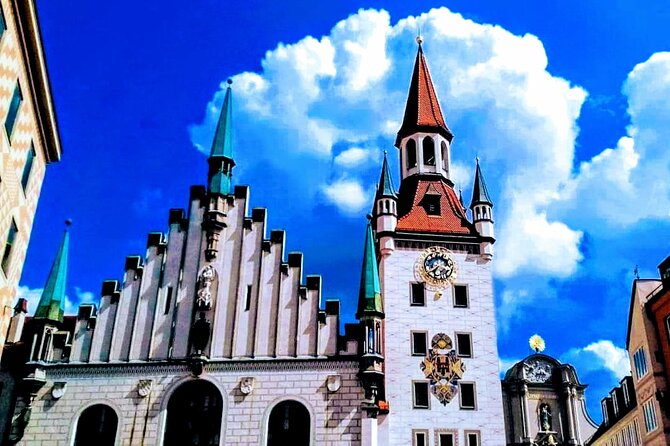
The first city walk begins at Marienplatz, Munich’s civic center since the city’s founding in the 12th century. The square was called Schrannenplatz until 1852, but the Nazi-era details are the point here: the neo-Gothic New Town Hall carried swastika flags, and the Old Town Hall received a wide passage to handle growing traffic.
You then move to the Frauenkirche and St. Michael. These churches are not Nazi buildings, but they help explain the physical cost of the war. Historical images show the destruction caused by Allied bombing and the changes made during reconstruction.
The Frauenkirche was built in the late 15th century in about 20 years. St. Michael, built roughly a century later in the Mannerist style, contains one of the world’s largest barrel vaults. Each stop lasts about 15 minutes, so do not expect a full church tour. Instead, you get a compact comparison between Munich before the war, Munich in ruins, and Munich rebuilt.
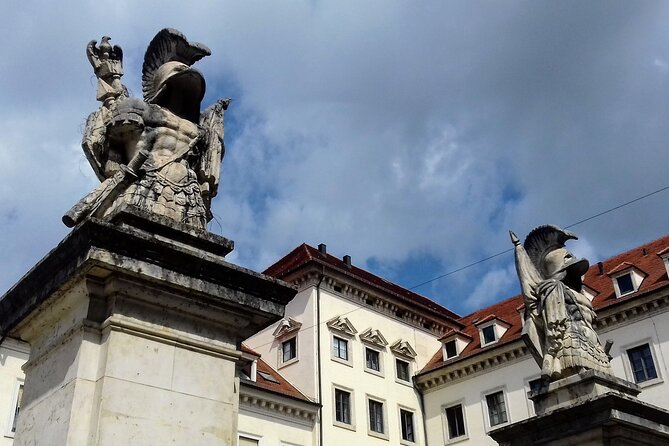
At the Residenz, the guide explains the large palace complex and its seven courtyards from outside. The Nazi connection is Christian Weber, an SS Brigade Leader who established his residence here in 1933. You also get the local tradition of touching one or more lions at the side entrances, a lighter detail in an otherwise grim morning.
Other guided visits to the Dachau memorial site:
- Dachau Concentration Camp Memorial Site Tour from Munich by Train
★ 4.5 · 5,637 reviews - From Munich: Dachau Memorial Site Day Tour
★ 4.8 · 2,723 reviews - From Munich: Dachau Memorial Site Half-Day Trip
★ 4.7 · 2,526 reviews
From the Feldherrnhalle to the White Rose
Viscardigasse is a tiny stop, lasting only about two minutes, but it carries a sharp lesson. Your guide explains why locals called it Drückebergergäßchen, or the lane of shirkers. The nickname points to people who used the side street to avoid giving the Nazi salute at the Feldherrnhalle.
At the Feldherrnhalle, Hitler’s failed 1923 putsch ended in bloodshed. This is one of the places where Munich’s ordinary streets became part of the Nazi movement’s origin story. Afterward, the driver takes you to several outlying stops, which is far more practical than trying to cover them all on foot.
The memorial at Platz der Opfer des Nationalsozialismus was erected in 1985 on the site of a destroyed Schiller monument. An eternal flame burns in a symbolic dungeon, representing freedom. The stop is brief, about five minutes, but the memorial gives the tour a clear focus on victims rather than only on Nazi leaders.
At Ludwig Maximilian University, you visit the memorial to the White Rose. Hans and Sophie Scholl, Christoph Probst, Alexander Schmorell, Willi Graf, and Professor Kurt Huber formed the resistance group. The Nazis murdered them in 1943.
I especially like that this part of the route is given about 25 minutes. The White Rose story puts young people, students, and moral choices at the center. It also keeps the tour from becoming a parade of Hitler addresses and monumental architecture.
Schwabing, the Hofbräuhaus, and Nazi-era buildings
In Schwabing, the guide points out places tied to the political and social world of the period. Hitler visited the Osteria Italiana, which still exists. The Völkischer Beobachter editorial office and Heinrich Hoffmann’s National Socialist picture publishing house were also located in the district.
You also hear about Hitler’s 1929 meeting with Eva Braun at the later Photohaus Hoffmann. The stop lasts about 20 minutes, enough for context but not for extended indoor visits.
The Hofbräuhaus is scheduled for an hour. Hitler and his associates used a first-floor niche for meetings, while the ground-floor Schwemme and inner courtyard offer a possible lunch stop. Lunch is not included, so plan for that expense separately.
I like the contrast here. The Hofbräuhaus is still a functioning beer hall rather than a preserved political museum, and your guide can explain its role without turning the entire stop into a solemn memorial. At the same time, the setting can feel crowded and social, which may be jarring after the White Rose memorial. You should decide in advance whether you want a substantial meal or only a look inside.
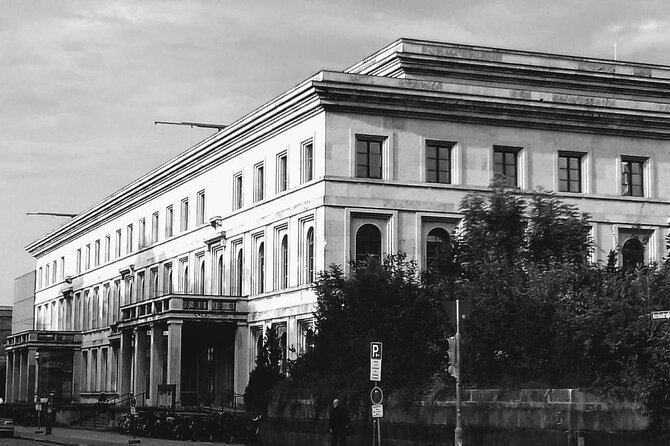
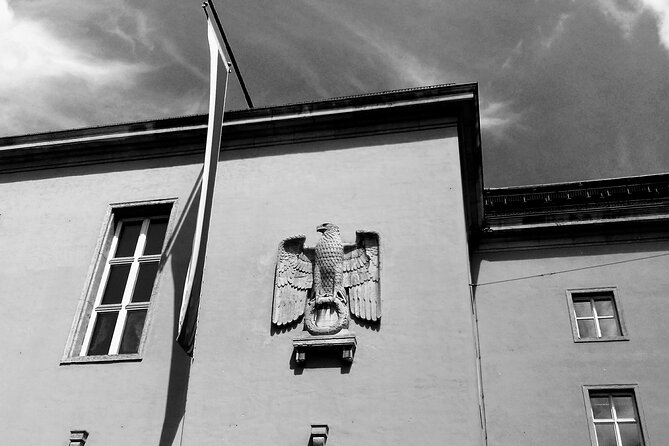
The Altstadt-Lehel stop brings you to the former Reich Aviation Ministry building, erected in 1937 for Luftgaukommando V. Its 225-meter main front and surviving Nazi symbols make the scale of government power clear. At Haus der Kunst, the former House of German Art, you see the first major representative Nazi building in Munich. Its long row of granite columns earned it the nickname Weißwurst-Allee.
The exterior stops are short, generally five minutes. That is enough to identify the buildings, but not enough for a detailed architectural visit. This tour is about connections and explanation, not museum admissions.
A brief pause at the Eisbachwelle
The Eisbachwelle offers a useful change of mood. Near Haus der Kunst, you watch surfers handle Munich’s famous artificial standing wave. The scheduled visit lasts about 10 minutes.
This does not erase the morning’s subject, and it should not. It simply gives your mind a short break before the route returns to Hitler’s private residences and Nazi planning. The stop also shows present-day Munich using a former political setting as ordinary public space.
Other Third Reich and wartime history tours in Munich:
- Munich: Third Reich & WWII Walking Tour
★ 4.6 · 6,181 reviews - Third Reich Walking Tour Munich
★ 4.5 · 4,291 reviews - Munich: Birthplace of the Third Reich Guided Walking Tour
★ 4.6 · 771 reviews - Munich World War II Sites Including Dachau Concentration Camp
★ 4.5 · 570 reviews
Hitler’s addresses and Nazi model projects
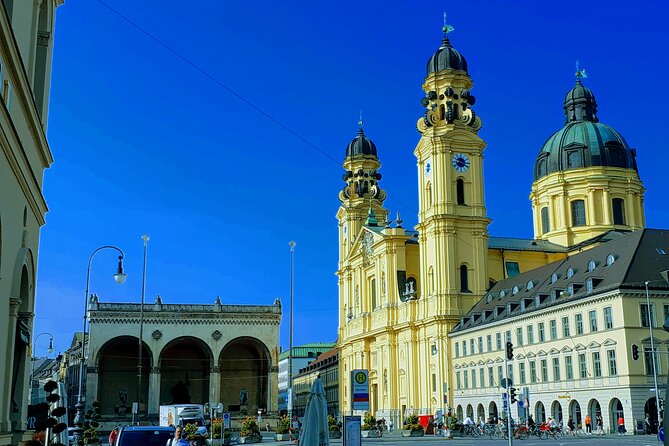
In Bogenhausen, the vehicle passes Hitler’s former home, a luxurious 317-square-meter, nine-room apartment where he lived from 1929. The building is now a police station and can only be viewed from outside.
Nearby, you see the site where Eva Braun lived in a villa from 1936. The house itself was demolished several years ago. This is a useful reminder that not every stop offers a surviving structure. Sometimes the value is in understanding what occupied a particular part of the city.
On Prinzregentenstraße, you see an apartment building for the Nazi upper class, flanked by air-raid shelters. It was meant to serve as a model for similar housing, but the war prevented more examples from being completed.
Ramersdorf adds another side of Nazi planning. Nearly 200 settlement houses with private gardens were built there in 1934 for German national comrades. The settlement was intended as a model and is now protected as a historic site.
These stops help you see how ideology reached beyond party offices and military buildings. It shaped housing, status, public image, and ideas about who belonged. The drawback is that most visits are only five or 10 minutes, so you will rely heavily on the guide’s explanation rather than extensive time on site.
Stadelheim and the final Munich circuit
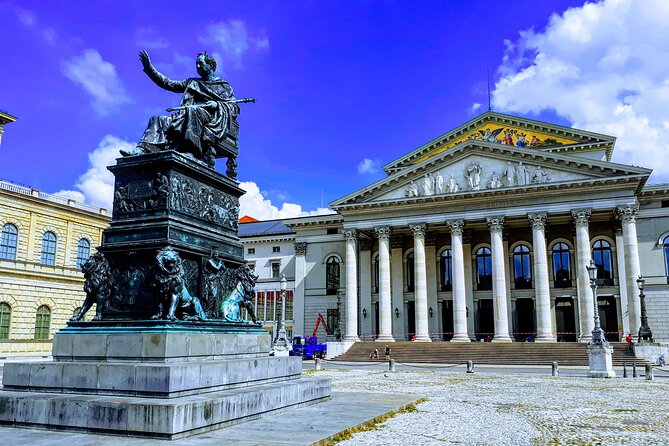
At Stadelheimer Straße, the guide explains that members of the White Rose were guillotined at the Stadelheim prison in 1943. Their graves are in the nearby Perlacher Forest cemetery.
This stop carries more weight after visiting the university memorial. You have already met the group as students and resistance members. Here, the story reaches its brutal end. The scheduled time is about 15 minutes.
Königsplatz then brings you into the former administrative center of the Nazi Party. The area between Königsplatz and Karolinenplatz included party offices and the Führerbau. Many Nazi buildings survived the bombing, and the NS Documentation Center opened in 2015 on the site of the destroyed Brown House.
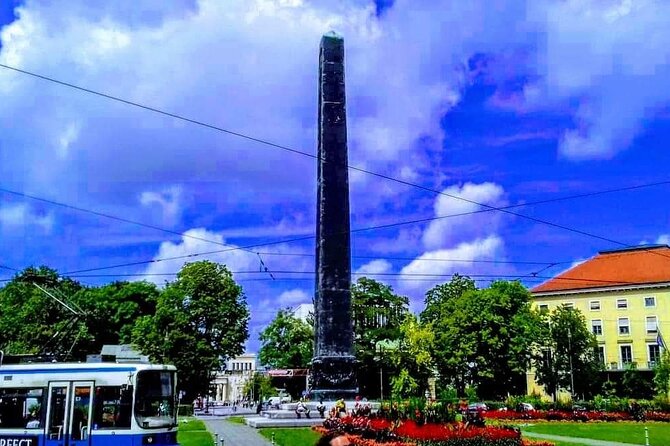
At Karolinenplatz, the guide connects the Nazi power center with the older 19th-century city designed under King Ludwig I. The obelisk dates from 1833. In Maxvorstadt, you see the renovated apartment where Hitler shared a shabby room with Austrian Rudolf Häusler after moving to Munich in 1913 as an unsuccessful postcard painter.
The guide also points out the location planned for Hitler’s mausoleum and adjoining Hall of the Party. The plan was inspired by Napoleon’s tomb at Les Invalides in Paris. These details show the grand scale of Hitler’s ambitions, even when the original buildings are gone.
Dachau, where the day becomes much heavier
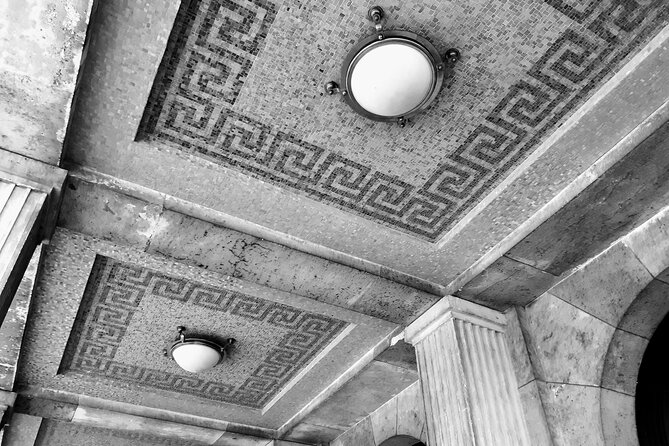
The drive to Dachau changes the pace and emotional weight of the experience. Before entering the memorial, the guide shows you some of the luxurious villas on the former SS grounds.
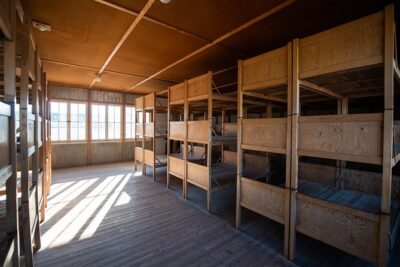
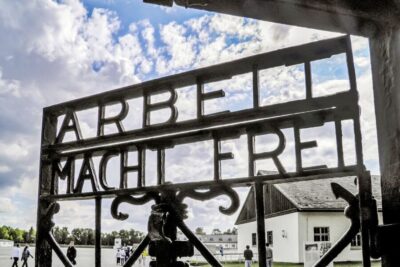
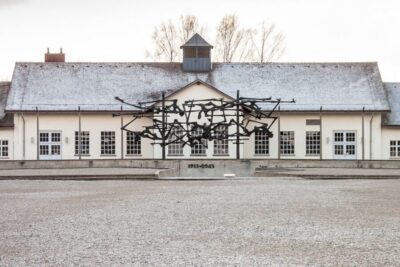
Dachau opened six weeks after Hitler became Chancellor. During its 12 years, more than 200,000 people were imprisoned there, and 41,500 were murdered. Those figures are difficult to process as numbers alone. The site gives them a physical setting, and a licensed guide can explain how the camp functioned and why Dachau became a model for the wider concentration camp system.
The memorial visit usually lasts 1.5 to 2.5 hours. That range is important. A two-hour visit is enough for a serious introduction, but you should not expect to see every display or read every panel at length. The grounds include coarse pebble paths, so wear firm, comfortable shoes.
The concentration camp memorial is not recommended for children under 12. Even older children may need preparation, depending on their maturity and interest. This is not a casual sightseeing stop, and you should leave room afterward for a quiet evening rather than packing another major activity into the schedule.
Is $804.18 per person good value?
At $804.18 per person, this is an expensive Munich experience. The value depends almost entirely on group size and your need for a private guide.
For one or two people, the cost is difficult to justify unless you place a high value on door-to-door pickup, a private vehicle, and a full day of personalized explanation. For a larger private group, the price may feel more reasonable, especially with group discounts available. You are paying for transport, a chauffeur, a licensed Munich and Dachau guide, mineral water, and a route that would be awkward to manage by public transport.
There are no hidden tour costs listed, but lunch and tips are extra. Pickup outside Munich, including Munich Airport, may also involve an added charge. Confirmation is sent within 48 hours, subject to availability.
Free cancellation is available up to 24 hours before the start time. Changes or cancellations inside that window are not accepted for a refund.
Who should book this Munich and Dachau tour?
I would choose this tour if you want Nazi-era Munich explained as one connected story rather than as separate landmarks. It suits adults, history-focused visitors, families with older teenagers, and private groups that prefer a flexible vehicle to a large coach.
I would not choose it if your main goal is a relaxed Munich city tour, a long museum visit, or a low-cost outing. The schedule is packed, many stops are exterior views, and the subject matter becomes increasingly difficult as the day continues.
You should also be comfortable with the tour’s mix of solemn memorials, ordinary city life, and brief lighter stops such as the Eisbachwelle and Hofbräuhaus. That contrast is part of the experience, but it will not suit everyone.
Should you book it?
Book this private tour if you want detailed guidance, hotel pickup, and a full route covering both Munich and Dachau in one day. Its strongest feature is the connection between places: the Feldherrnhalle, the White Rose memorial, Nazi party buildings, private residences, and the concentration camp all become parts of one story.
The price is the deciding factor. A small group can get better value than a solo visitor, while anyone seeking budget transport should look elsewhere. If you book, wear good shoes, prepare yourself for Dachau, and keep the evening free. This is a serious day, but for the right visitor, it offers a clear and thoughtful way to face Munich’s most difficult past.
FAQ
How long does the private Munich and Dachau tour last?
The tour lasts approximately 9 hours and 30 minutes, including the Munich route and the visit to Dachau Concentration Camp Memorial Site.
Where can pickup take place?
Pickup is available at any hotel or address in Munich. Pickup and return outside Munich, including Munich Airport, may be possible on request, with possible additional costs.
What time does the tour begin?
Pickup can be arranged for 8:00 a.m., 9:00 a.m., or 9:30 a.m. Another time may be possible if requested in advance.
Is this a private tour?
Yes. Only your group participates. A VW or Mercedes minivan is used for groups of up to seven people, while larger groups travel in a small coach with a driver.
Is lunch included?
No. Lunch is not included in the tour price. The Hofbräuhaus is suggested as a possible lunch stop, but you pay for your meal separately.
How long do you spend at Dachau?
The average visit at Dachau Concentration Camp Memorial Site lasts between 1.5 and 2.5 hours.
Is Dachau suitable for children?
Visiting Dachau is not recommended for people under 12 years of age. The memorial also includes coarse pebble paths, so suitable footwear is advised.
Recently reviewed in Munich
- München: Vegetarische Viktualienmarkt-Probiertour Deutsch★ 4.8 · 6 reviews
- Wright Europe Vacations – Private Escorted Auto Tours★ 5.0 · 35 reviews
- Best of Munich Electric Bike Tour★ 5.0 · 38 reviews
- Munich Walking Quiz: Explore and Discover the City’s Highlights★ 5.0 · 7 reviews
- Walking Tour on Resistance to Nazism in Munich★ 5.0 · 8 reviews
- Private Transfer from Munich to Salzburg with 2 hours for sightseeing★ 4.5 · 13 reviews
- Private Transfer from Munich to Vienna with 2 hours for sightseeing★ 4.5 · 6 reviews
- 2 hour Sights Guided E-Scooter Tour in Munich★ 4.0 · 6 reviews
Dachau Memorial Tours, compared.
Dachau Concentration Camp Memorial Site Tour from Munich by Train
Read our review →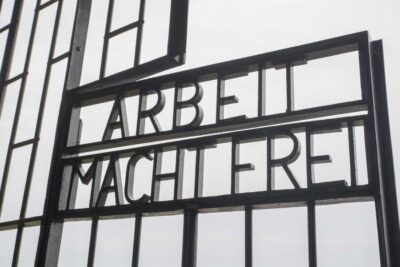
Dachau Concentration Camp Memorial Tour with Train from Munich
Read our review →
Full-Day Dachau Concentration Camp Memorial Site Tour from Munich
Read our review →
Dachau Small-Group Half-Day Tour from Munich By Train
Read our review →
Munich World War II Sites Including Dachau Concentration Camp
Read our review →Browse the lists this tour appears in