
Reviewed · MUNICH THIRD REICH & WWII TOURS
Munich: Third Reich and World War II Private Guided Tour
Munich’s Nazi past is not hidden in a far-off museum. It runs through the center of town, from Marienplatz to Hofbräuhaus, Feldherrnhalle, the former Nazi offices, and Königsplatz. This private walking tour gives those familiar streets a difficult new meaning, with time to ask direct questions about Hitler, Nazi supporters, resistance groups, and Munich’s role in the movement.
I like the private format, since a subject this serious is better handled at your pace than in a large group. I also like the route’s clear historical arc, from the Beer Hall Putsch to the 1945 destruction of Munich. The main drawback is the price, $311 per person, and the basic 3-hour version does not include the NS Documentation Center. If you want the museum, plan on 4.5 hours.
Key points at a glance
- Marienplatz begins the story: See where Nazi propaganda events took place and learn how Munich became the movement’s political center.
- Hofbräuhaus connects beer hall culture with Nazi politics: The tour explains Hitler’s 1920 speech and the origin of the National Socialist German Workers’ Party.
- The Beer Hall Putsch route brings the failed coup to life: Walk toward Feldherrnhalle and Odeonsplatz while hearing how the event shaped Hitler’s later political career.
- Resistance receives real attention: Learn about the White Rose Group, led by five university students who opposed the Nazi regime.
- The 4.5-hour choice adds the NS Documentation Center: Photographs, documents, films, and media stations give the street tour more context.
- Mireya is one guide to look for: A verified booking specifically praises her by name, while the tour also offers English, German, French, Italian, and Spanish.
What this Munich history tour is really about
This is not a general city walk with a few Nazi-era references added for atmosphere. It focuses on Munich’s role in the creation, growth, and eventual collapse of National Socialism.
You begin in the Old Town and follow a route through places connected to Hitler and the Nazi Party. The guide explains not only what happened at each location, but also how propaganda, political violence, public support, and opposition shaped the city.
That distinction matters. A building can look ordinary after reconstruction, yet its past may include speeches, government meetings, forced political change, or decisions that affected all of Europe. Your guide helps connect the present-day street to that earlier use without treating the subject as a collection of dramatic anecdotes.
The tour also asks uncomfortable questions about Munich’s citizens. How did the city become the capital of the Nazi movement? Who supported Hitler? Who resisted? What happened when the regime lost the war? You should expect a serious tone, though the private setting gives you room to ask questions that may not fit a standard group tour.
Other Third Reich and wartime history tours in Munich:
- Munich: Third Reich & WWII Walking Tour
★ 4.6 · 6,181 reviews - Third Reich Walking Tour Munich
★ 4.5 · 4,291 reviews - Munich: Birthplace of the Third Reich Guided Walking Tour
★ 4.6 · 771 reviews
Starting at Marienplatz and the 1945 destruction
The meeting point is in front of Hotel BEYOND by Geisel at Marienplatz 22, opposite St. Peter’s Church. Do not go inside the hotel. It is only a landmark for meeting your guide, and hotel staff are not informed about the tour.
Marienplatz is a useful starting point because it places you at the center of Munich’s public life. The square hosted Nazi propaganda events, so the tour begins by showing how political movements used a familiar civic space to reach ordinary people.
You will also see the reconstructed New Town Hall. Its postwar appearance helps introduce one of the tour’s important themes: Munich’s center was heavily damaged by bombing in 1945. The buildings around you are not simply old survivors. Many were rebuilt, repaired, or altered after the war.
I find this opening valuable because it avoids treating wartime destruction as an isolated event. The guide links the physical damage to Munich’s political past and to the city’s later effort to live with that past.
Marienplatz is also practical for your day. It is central, easy to find, and surrounded by major sights. The tour begins on foot, so wear shoes suitable for city streets and expect to remain outside for much of the 3-hour option.
Hofbräuhaus and the birth of the Nazi movement
The route continues toward Hofbräuhaus am Platzl, one of Munich’s best-known beer halls. Here, the guide explains Hitler’s 1920 speech connected with the founding of the National Socialist German Workers’ Party.
That stop helps explain why the movement’s origins cannot be separated from Munich’s political and social setting. The beer hall was not just a place to eat and drink. It could also serve as a public room for speeches, arguments, and political organizing.
You should not expect a staged reenactment or a sensational presentation. The value is in understanding how political ideas moved from private meetings into public life. The guide also discusses Nazi supporters and the process by which Hitler gained influence.
Hofbräuhaus remains an active public venue, so this part of the walk takes place in a living city rather than a preserved historical set. That can feel jarring, but it is also the point. The building’s present use sits beside its troubling past.
If you have already visited Hofbräuhaus for its food or atmosphere, the tour gives you a different way to read the place. If you have not visited, you will still understand why it matters to the route without needing to stop for a meal.
Following the Beer Hall Putsch to Feldherrnhalle
One of the strongest sections is the walk from the beer hall area toward Feldherrnhalle and Odeonsplatz. The guide traces the route of the Beer Hall Putsch, Hitler’s failed attempt to seize political power in Bavaria.
The event matters for more than its failure. It became part of the Nazi movement’s political mythology, and its aftermath helped shape Hitler’s next steps. The tour connects the putsch with his imprisonment and the writing of Mein Kampf, his semi-autobiographical political manifesto.
Walking the route makes the geography easier to understand. You are not only hearing that a coup attempt happened in Munich. You are seeing the streets and civic spaces involved, and you can ask your guide to clarify the sequence of events.
Feldherrnhalle is also a place where the guide can explain how later Nazi propaganda used memory and ceremony. Political movements often turn failed events into symbols. Here, the tour shows how the Nazis presented the putsch as part of their heroic origin story.
Odeonsplatz gives the route a strong sense of movement. You have left the early political meeting place and followed the attempt to turn words and organization into direct action. That progression makes the first half of the tour feel like a connected story rather than a list of addresses.
A few more Munich tours worth comparing
- Munich Private Tour with a Local – Highlights & Hidden Gems
★ 5.0 · 469 reviews - Mike’s Neuschwanstein & Linderhof Private Tour from Munich
★ 5.0 · 197 reviews - Dachau Concentration Camp Private Tour by Train from Munich
★ 5.0 · 185 reviews - Fall in Love with Munich in a Private Old Town Walking Tour
★ 5.0 · 182 reviews
The White Rose and Munich’s resistance
The tour does not focus only on Hitler and Nazi institutions. It also covers opposition to the regime, including the White Rose Group led by five university students.
This is an important balance. A tour about Nazi Munich can easily become too centered on the men who gained power. By including the White Rose, the guide shows that resistance existed inside the city, even though resisting the regime was dangerous.
The subject also gives you a better way to understand moral choice under dictatorship. Resistance was not limited to military plots or public uprisings. Students could oppose the government through political statements and the circulation of ideas, yet still face severe consequences.
The supplied information does not specify a separate White Rose memorial stop or the exact amount of time spent on the group. Treat it as one part of the wider walking route, not as a dedicated museum visit. If this is the period that interests you most, ask your guide at the start to give it proper attention.
I appreciate that this part keeps the tour from presenting Munich as simply a city of Nazi buildings and official ceremonies. It brings individuals back into the story, including people who challenged the regime from within German society.
Nazi offices, the Munich Agreement, and the Monument to the Victims
Along the route, you will see former Nazi Party office buildings and the Monument to the Victims of National Socialism. These stops shift the focus from political speeches to the machinery of power and the cost of the regime.
The former Führerbau, or Führer’s Building, is especially significant. It was where Neville Chamberlain and Adolf Hitler signed the Munich Agreement in 1938. The building connects Munich directly with a major moment in the diplomatic history leading toward World War II.
You should keep your expectations realistic. The experience is a walking tour, not a full interior visit of every historic building. The value comes from seeing the sites, understanding their former roles, and hearing your guide explain how they fit into the larger story.
The Monument to the Victims of National Socialism changes the mood again. Its inclusion matters because the tour is not only about Nazi leaders, offices, and public spectacle. It also asks you to remember the people harmed by the regime.
This is where a private guide can be especially useful. You can pause to ask about terminology, responsibility, memory, or the difference between official buildings and memorial spaces. A large group may move on quickly. A private tour can give the discussion more room, depending on your guide and questions.
Königsplatz and the end of the 3-hour route
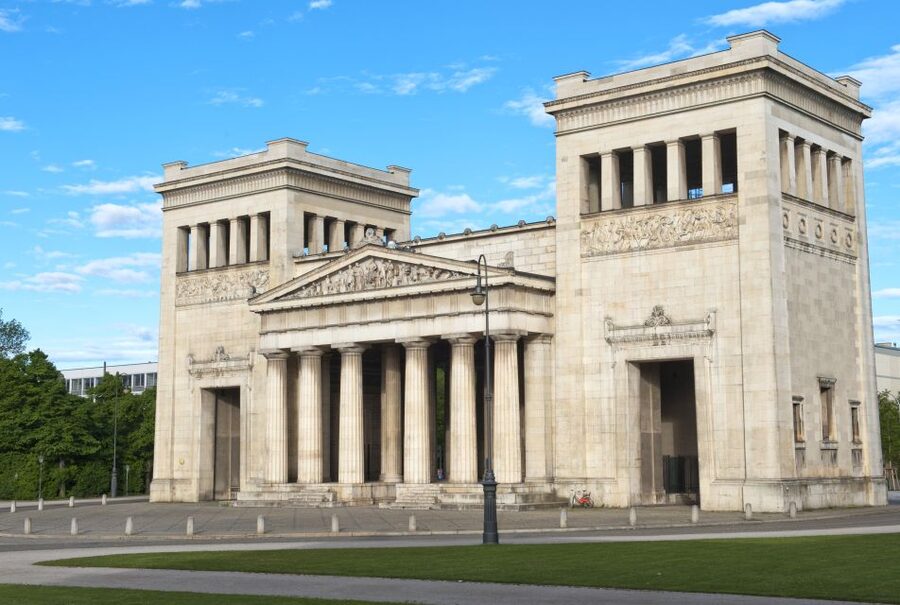
The basic walking tour ends at Königsplatz. During the Nazi period, the square was used for mass rallies and book burning.
Königsplatz gives the route a fitting final stop because it brings together public spectacle, ideology, and the use of urban design for political theater. A grand square can be presented as a symbol of national unity, but it can also be used to stage conformity and intimidate opponents.
The stop also completes the route’s movement from early party organizing to full state power. At Marienplatz and Hofbräuhaus, you hear about public speeches and the growth of the movement. At Feldherrnhalle, you follow a failed attempt to seize power. At Königsplatz, you see the setting for mass political display.
The 3-hour version is long enough to give you a serious introduction, but it will not cover every aspect of Nazi Germany or Munich’s wartime experience. If you want a focused city walk with major locations, it works well. If you want museum exhibits, more visual evidence, and added time for questions, choose the longer option.
What the 4.5-hour option adds
The 4.5-hour version includes the Munich Documentation Center for the History of National Socialism. This is the clearest upgrade for anyone who wants more than outdoor landmarks.
The center presents photographs, documents, texts, film projections, and media stations. Its subject range includes the origin and rise of the Nazi movement, the war, and the postwar period in Munich.
That extra material changes how you understand the walking route. On the streets, you are dealing with places and events. In the documentation center, you can work through evidence and interpretation. The two parts support each other.
You also keep your private expert guide for the museum visit. That matters because the material can be difficult and dense. Your guide can answer questions about the causes and consequences of National Socialism and World War II, and help connect the exhibits to the locations you have just seen.
I would choose 4.5 hours if this is a main reason for visiting Munich, if you have limited knowledge of the period, or if you prefer documents and photographs to relying on a spoken explanation alone. The extra time also reduces the pressure to rush through the subject.
The tradeoff is simple: you need to give up more of your day, and the visit may feel emotionally heavy. This is not a light sightseeing add-on. It is best scheduled when you have time afterward to process what you have seen.
Private guide, languages, and group feel
The tour is offered as a private group experience, with live guiding in English, German, French, Italian, and Spanish. You should select the language you want when checking availability.
A private booking is the main reason the relatively high price can make sense. At $311 per person, the cost is not aimed at the budget museum visitor or the solo sightseer looking for a cheap orientation walk. You are paying for a dedicated guide, a focused route, and the chance to shape the conversation.
The value improves if you are traveling with several people who care about the subject. A private group can divide the cost among its members, though the quoted price is per person. For one person or a small pair, the price feels harder to justify unless this topic is a central purpose of your Munich visit.
One specific guide name is available: Mireya received a direct positive mention after a verified booking. That does not guarantee she will lead your tour, so check the assigned guide rather than booking on the assumption that you will meet her. The overall rating is 4.8 from 20 reviews, with additional positive comments describing another booking as perfect.
The review information is limited, so I would not use it to predict every guide’s style. Still, the strong overall score and the named praise for Mireya suggest that guide quality is an important part of the experience.
Practical details before you book
The route is wheelchair accessible, which is useful for a city walk through central Munich. The exact starting time depends on availability, so check the schedule before building the rest of your day around it.
The meeting point is precise: in front of Hotel BEYOND by Geisel at Marienplatz 22, opposite St. Peter’s. Again, do not enter the hotel to ask for help. Meet outside.
The activity lasts either 3 hours or 4.5 hours, depending on your choice. The longer option includes the NS Documentation Center, while the shorter route ends with the outdoor sites at Königsplatz.
You can cancel up to 24 hours before the tour for a full refund, and the booking option allows you to reserve now and pay later. Those policies are useful if your Munich schedule is still shifting, but the bigger planning question is energy. The subject is serious, and the longer version takes up a substantial part of the day.
Who should book this tour?
I would recommend it to you if you want a focused explanation of Munich’s Nazi past, prefer asking questions as you go, or are traveling with family or friends who want a private guide rather than a standard group walk.
It is also a good choice if you already know the broad outline of Hitler’s rise but want to understand the specific Munich locations connected to it. The route adds place and scale to events that can otherwise feel abstract.
The 4.5-hour option is best for history students, museum-minded visitors, and anyone who wants evidence from photographs, documents, films, and media stations. The 3-hour option suits you if you want the main sites without committing half a day to the subject.
I would skip it if you want a light introduction to Munich, dislike walking tours, or have little interest in political history. The subject is not treated as casual sightseeing, and the price is high for a short activity unless the private format matters to you.
Should you book the Munich Third Reich tour?
Book this tour if Munich’s role in National Socialism is high on your list and you want a private guide to connect the major sites. The itinerary has a strong shape, the resistance story prevents it from becoming leader-centered, and the museum option adds useful documents and visual material.
For the best value, bring a small group and choose the 4.5-hour version. If your schedule is tight, the 3-hour walk still covers the key route from Marienplatz to Königsplatz. Just know that you are paying for a serious, specialized history experience, not a general city tour.
FAQ
Where does the tour meet?
Meet your guide outside Hotel BEYOND by Geisel at Marienplatz 22, 80331 Munich, opposite St. Peter’s Church.
Should I enter the hotel at the meeting point?
No. The hotel is only a meeting landmark, and its staff are not informed about the tour.
How long does the tour last?
You can choose a 3-hour walking tour or a 4.5-hour option that includes the NS Documentation Center.
What does the 3-hour tour include?
It includes a private guided walk through Munich’s Old Town and sites connected with the Third Reich, including Marienplatz, Hofbräuhaus, Feldherrnhalle, Odeonsplatz, the former Nazi Party offices, and Königsplatz.
Is the NS Documentation Center included in every option?
No. The Documentation Center is included only in the 4.5-hour option.
Which languages are available?
Guiding is available in English, German, French, Italian, and Spanish.
Is this a private group tour?
Yes. The experience is offered as a private group tour with a live guide.
Is the tour wheelchair accessible?
Yes, the activity is listed as wheelchair accessible.
Can I cancel for a refund?
You can cancel up to 24 hours in advance for a full refund. You can also reserve now and pay later.
Recently reviewed in Munich
- München: Vegetarische Viktualienmarkt-Probiertour Deutsch★ 4.8 · 6 reviews
- Wright Europe Vacations – Private Escorted Auto Tours★ 5.0 · 35 reviews
- Best of Munich Electric Bike Tour★ 5.0 · 38 reviews
- Munich Walking Quiz: Explore and Discover the City’s Highlights★ 5.0 · 7 reviews
- Walking Tour on Resistance to Nazism in Munich★ 5.0 · 8 reviews
- Private Transfer from Munich to Salzburg with 2 hours for sightseeing★ 4.5 · 13 reviews
- Private Transfer from Munich to Vienna with 2 hours for sightseeing★ 4.5 · 6 reviews
- 2 hour Sights Guided E-Scooter Tour in Munich★ 4.0 · 6 reviews
Munich Third Reich & WWII Tours, compared.
Birthplace of the Third Reich Guided Walking Tour
Read our review →
Munich World War II Sites Including Dachau Concentration Camp
Read our review →
Munich 3-Hour Segway Tour: Nazi Munich & Royal Architecture
Read our review →
Dachau Concentration Camp Memorial Site And Third Reich Day Tour From Munich
Read our review →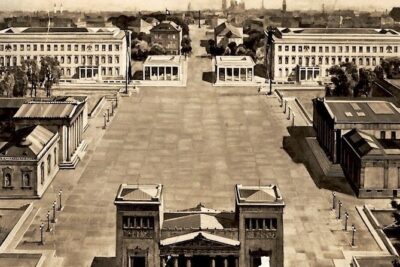
Browse the lists this tour appears in