
Reviewed · MUNICH GHOST & LEGEND TOURS
Munich: Scary Tour with actors in GERMAN
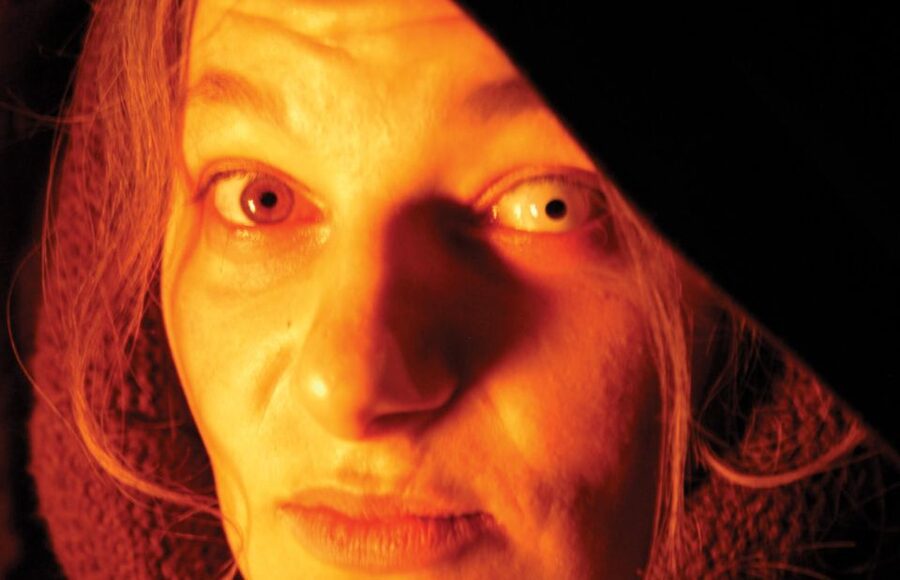
Munich’s old center gets a very different mood after dark. Costumed actors bring out witches, hangmen, pimps, alchemists, and the Devil himself, turning familiar streets into scenes from the city’s grim past. I especially like the mix of carefully researched history and live theater, plus the way the route links major sights to unsettling stories.
I also like the strong sense of place. You walk from Karlstor to St. Michael’s, the Frauenkirche, the Town Hall, St. Peter’s Church, and the Old Town Hall while hearing why executions took place outside the city and why prostitution vanished from the historic center. The main consideration is simple: the tour is in German only, so you need solid German skills to follow the stories and jokes.
Key points
- Witches, executions, and the Devil: The stories focus on Munich’s darker chapters, not just its grand buildings.
- Actors in historic costumes: Live scenes break up the walking and make the facts easier to remember.
- A useful central route: You pass Karlstor, St. Michael’s, the Frauenkirche, the Town Hall, St. Peter’s, and the Old Town Hall.
- A 90-minute evening outing: The tour offers a compact way to see the old center with a theatrical twist.
- German-language performance: The humor, dialogue, and historical detail work best for fluent German speakers.
- Rain or shine: Dress for the forecast, since the walking tour goes ahead in all weather.
Munich’s dark side begins at Karlstor
The meeting point is beneath the archway of Karlstor at Karlsplatz, also called Stachus. Look for the guide carrying a big blue bag marked with the white words Weis(s)er Stadtvogel. This is a useful landmark in a busy square, and it removes some of the usual uncertainty before a walking tour.
From here, the story begins with people being led out of Munich toward execution. That opening immediately sets the tone. You are not simply hearing dates beside pretty buildings. You are being placed inside a city where punishment was public, superstition shaped law, and certain occupations carried a heavy social stain.
The route takes you through the historic center rather than requiring transport between stops. That keeps the evening simple, though you should expect to walk and remain outdoors for the full 90 minutes. Comfortable shoes matter more than dressy evening clothes.
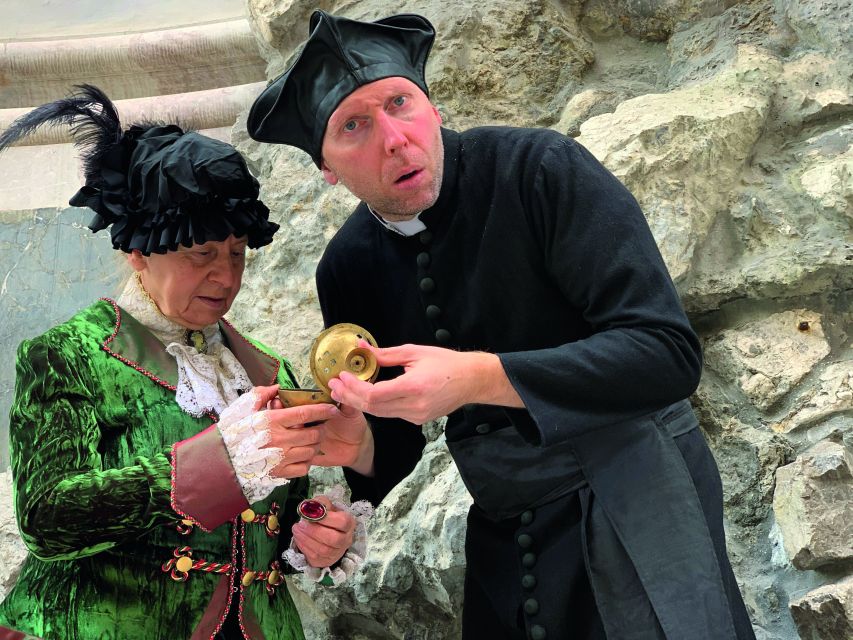
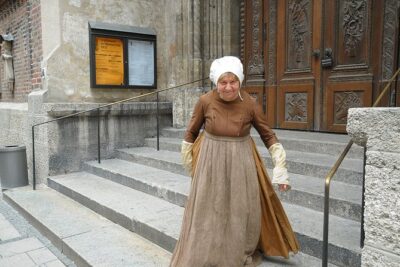
The actors are a key part of the experience. Instead of one guide speaking without interruption, scenes break up the route and give the stories a human face. The acting also helps explain connections that might otherwise sound like a list of grim facts.
More ghost and legend walks in Munich:
- Munich Ghosts and Spirits Evening Walking Tour
★ 5.0 · 1,900 reviews - Munich: Spooky Tour of Old Town in German
★ 4.6 · 1,112 reviews - Munich: Raven Black Witches and Executioners Walking Tour
★ 4.7 · 294 reviews
Salzstraße and the fear of witchcraft
Passing along historic Salzstraße, you reach the former Jesuit school, a place tied to the period of witch hunts. Here the tour reaches back to the 16th century, when unusual events could be blamed on supernatural forces.
One scene centers on an argument between Duchess Renata and Jesuit Father Ignatius. The dispute follows the collapse of the tower during construction of St. Michael’s Church. Rather than treating the accident as a simple building failure, people blamed the disaster on cursed women and an unnatural storm.
This part is useful because it shows how fear worked. Witchcraft was not just a collection of spooky tales added later for entertainment. It could shape explanations for accidents, illness, and bad weather, with serious consequences for people accused of causing them.
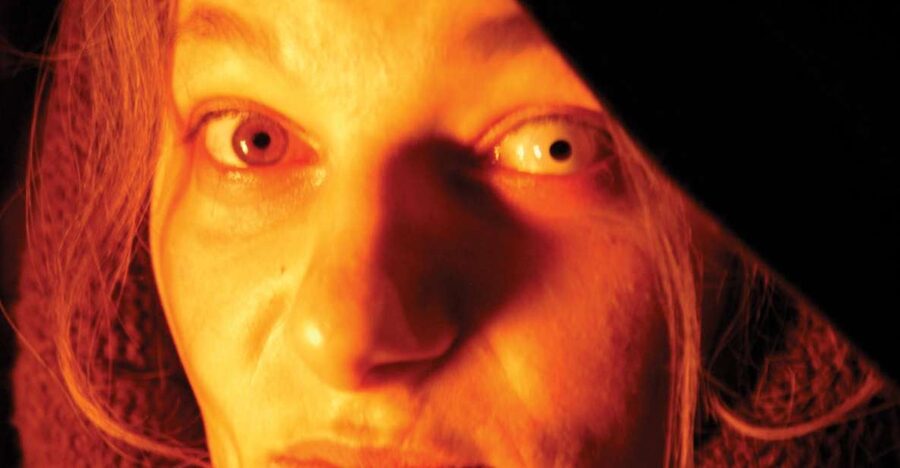
You will also hear about witch potions, broom rides, toad tongues, and children’s hands. These details are deliberately strange, but the performance uses them to show how stories about witches were built from rumor, religious belief, and fear.
The theatrical approach makes this section easier to follow than a dry account of witch trials. Still, the content can be unsettling. If you prefer light sightseeing, this is not a gentle introduction to Munich.
The Schöner Turm and one unfortunate goldsmith
At the Schöner Turm, the focus shifts from witchcraft to a doomed goldsmith. The story adds another layer to the tour’s main subject: Munich’s justice system could be harsh even when the charge involved an ordinary trade or a single unfortunate event.
The stop is valuable because the buildings are not just scenery. The tower becomes a setting for a personal story, and the historical center feels less polished and distant. You begin to picture the streets as places where accusations, punishments, and public gossip shaped daily life.
The actors help here by giving the scene pace and emotion. The performances are meant to pull you out of the steady rhythm of a normal walking tour. One of the most praised aspects of the experience is this change from explanation to drama, with the actors making the background information easier to remember.
Do not expect a full lecture on every legal detail. The stories are selected for their dramatic power and their connection to the route. You get an entertaining account of the past, with enough context to understand why each place matters.
The Frauenkirche and the Devil’s footprint
The Frauenkirche is the tour’s most famous setting. Here you meet the Prince of Darkness, and the story turns from human wrongdoing to a bargain with the Devil.
The central tale asks why the Devil helped the master builder construct the church. It also explains why the area around the building can feel so windy, then adds a wonderfully odd question about the Devil’s shoe size. This combination of architecture, local legend, and humor is typical of the tour.
The Frauenkirche is already one of Munich’s most recognizable sights, so the story gives you a fresh way to read the building. Instead of seeing only its towers and vast interior reputation, you hear how unusual features inspired supernatural explanations.
You should keep your expectations clear. This is a theatrical interpretation of legend, not a specialist architectural tour. The value lies in the way the performance connects a familiar landmark to the beliefs of earlier centuries.
The stop also shows why the experience works best after sunset or in evening darkness. The tour’s mood depends on the contrast between the handsome city center and the disturbing stories attached to it. The exact starting time varies, so check availability when booking.
Same city, a very different afternoon:
- From Munich: Neuschwanstein & Linderhof Castle Full-Day Trip
★ 4.5 · 12,494 reviews - Neuschwanstein & Linderhof Castle-Fairytale Day Tour from Munich
★ 4.5 · 7,275 reviews - Munich: Third Reich & WWII Walking Tour
★ 4.6 · 6,181 reviews - Dachau Concentration Camp Memorial Site Tour from Munich by Train
★ 4.5 · 5,637 reviews
The Town Hall and the alchemist who promised gold
The route continues to the magnificent Town Hall, where the alchemist Marco Bragadino appears. He presents himself as a supposed goldsmith and tries to draw you toward his arts.
This episode offers a change of pace. The tour is not only about official punishment and witch accusations. It also looks at fraud, ambition, and the old dream of turning common materials into wealth. The character of Bragadino adds comic energy after the darker witch stories.
I like this stop because it shows how the tour uses Munich’s public buildings as a stage. The Town Hall is more than a photo stop. It becomes a place where claims are made, trust is tested, and a colorful character tries to win an audience.
The acting can include the people on the tour. One recent participant specifically praised the way the performers involved the audience, and that detail is worth noting before you book. You may be asked to respond or take part in a scene, so this is not ideal if you want to remain completely unnoticed.
St. Peter’s Church and the daily life of a hangman
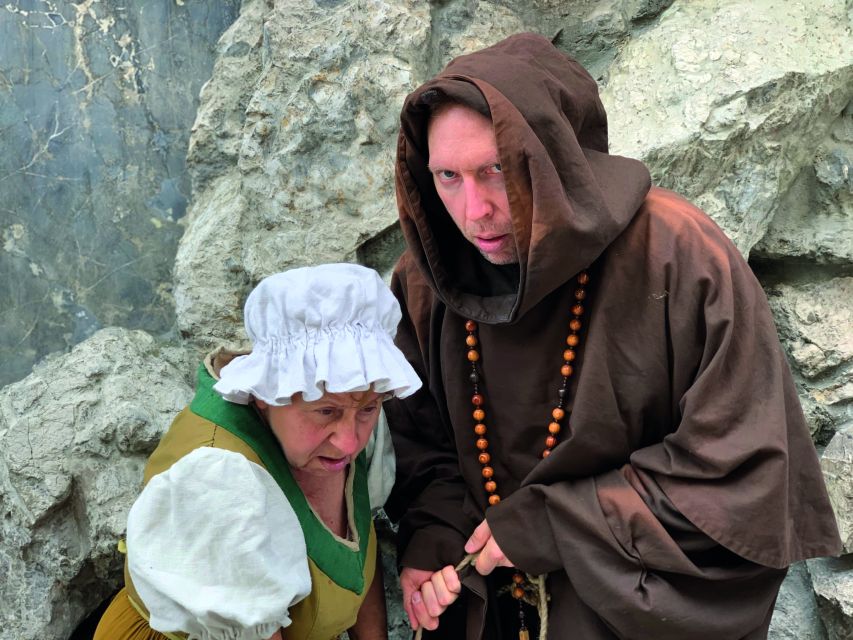
At St. Peter’s Church, the tour turns to the hangman. You learn what he looked like, how he lived, why people avoided him, and how someone might obtain a piece of gallows rope.
The most striking point is the contradiction in the hangman’s work. He was needed by the authorities, yet his profession could make him an outcast. The tour also explains that Munich’s hangmen were not limited to torture chambers or execution sites. They could work as pimps as well, linking the subjects of punishment, prostitution, and social exclusion.
This is one of the more unusual parts of the route. A conventional city tour might mention medieval justice in passing. Here, you get the human and social details that explain what the job meant in everyday life.
The stop also includes the story of a beautiful woman escaping certain death. That moment gives the evening a touch of suspense and prevents the subject matter from becoming a nonstop march toward misery.
St. Peter’s Church adds an important contrast. You are hearing grim stories beside one of Munich’s major religious landmarks. That setting helps explain how faith, law, punishment, and public life were closely linked in the old city.
The Old Town Hall, torture, and Munich’s former red-light district
At the Old Town Hall, the route crosses the site of the former torture chamber. The stories here are the most explicitly gruesome, with the building providing a fitting setting for accounts of interrogation and punishment.
The tour does not stop with executions. Near the Platzl, you learn that Munich’s red-light district remained in this part of the city until the Olympic Games of 1972. The area’s later image as an orderly, respectable center hides a more complicated past.
This section connects old customs with modern city planning. Prostitution did not simply vanish because attitudes changed overnight. The historic center was reshaped, and the red-light district was pushed out as Munich prepared for a new public image.
The tour links this story to the lyrics of Skandal im Sperrbezirk by the Spider Murphy Gang. You do not need to know the song to follow the point, but German speakers will get more from the cultural reference and its local flavor.
This final stretch gives the experience a broader time frame. You move from witch hunts and executions to a 20th-century change in city life. That helps the tour feel less like a collection of medieval horror stories and more like a look at how Munich decided what belonged in its center.
What the 90-minute format does well
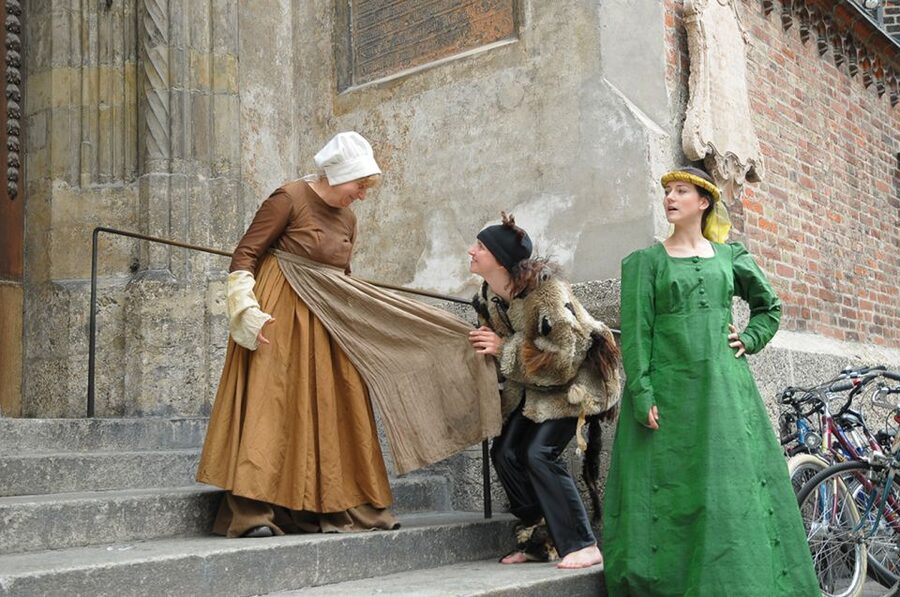
Ninety minutes is a useful length for this subject. It is long enough to cover the main route and several characters, but short enough to fit into an evening of sightseeing or dinner plans.
The pace should feel active because the tour combines walking with scenes at different stops. You are not standing in one place for a full lecture, though you will spend time listening outdoors. Since the tour takes place rain or shine, bring suitable clothing and shoes.
The compact format also forces the guide and actors to choose strong stories. You hear about witches, the Devil, an alchemist, a hangman, torture, and prostitution without spending an entire night on one period.
The tradeoff is depth. If you want a detailed academic account of Munich’s legal system, church construction, or red-light district, you will need another source or a specialist tour. This experience aims for clear storytelling and memorable facts rather than exhaustive detail.
German language and audience fit
The tour is conducted in German, with a live German-speaking guide and a professional team of actors in historic costume. This is not a tour where you can rely on occasional English summaries.
You should book it if you can follow spoken German at a comfortable pace, including historical vocabulary, jokes, character dialogue, and audience interaction. A participant specifically noted the lack of English or Chinese options, so language is the main practical limitation.
The subject matter suits adults and older children who enjoy spooky stories, local legends, and theatrical history. The focus on torture, executions, witch hunts, prostitution, and accusations of sorcery may not suit young children or anyone looking for a gentle evening walk.
It also works well for repeat visitors to Munich. If you have already seen the Frauenkirche, Town Hall, and St. Peter’s Church, the stories give those landmarks a new angle without requiring a long excursion outside the center.
Is $46 a fair price?
At $46 per person, this costs more than a basic city walk, but you are paying for more than a guide leading you from one landmark to another. The price includes the live guide and a professional cast in historic costume, with several staged scenes along the route.
The strongest value comes from the combination of theater and location. You get a guided look at major central sights, plus stories that are hard to discover by simply walking past the buildings. The acting also breaks up the information, which helps if you lose interest during standard history talks.
The value is weaker if you do not understand German or if you dislike audience participation. In that case, the central route is easy to walk independently, and much of the benefit comes from the spoken performance.
For German speakers who enjoy unusual local history, $46 is a reasonable price for a focused 90-minute evening experience. The high rating of 4.7 from 59 recorded ratings fits the tour’s main strengths: entertaining acting, useful background information, and a route that makes good use of Munich’s old center.
Booking advice for a smoother evening
Meet under the Karlstor archway at Karlsplatz and look for the large blue Weis(s)er Stadtvogel bag. Arrive with enough time to identify the meeting point, since Karlsplatz can be busy.
Wear shoes suitable for city walking and dress for the weather. The tour operates in rain or shine, and there is no promise of indoor shelter during the route.
The activity is wheelchair accessible, which is useful for many visitors, though the supplied details do not explain the exact route conditions at each stop. If you need specific access information, confirm it before booking.
You can cancel up to 24 hours in advance for a full refund, and the reserve-now-pay-later option lets you hold a place without paying immediately. These policies are helpful when your Munich schedule is still changing.
Should you book the scary tour?
Book this tour if you speak German well, enjoy live performance, and want Munich’s landmarks explained through witch hunts, punishment, legends, and social history. The actors are the main reason to choose it over a standard walking tour, and the route covers many of the city center’s essential sights.
Skip it if you need English, Chinese, or another language, or if torture and execution stories are not your idea of a good evening. For the right audience, this is a compact, entertaining way to see familiar Munich buildings through their stranger and darker stories.
FAQ
What language is the tour conducted in?
The tour is conducted in German. The live guide and the actors perform in German, and no English or Chinese option is provided in the available information.
How long does the tour last?
The tour lasts 90 minutes.
Where does the tour meet?
The meeting point is at Karlsplatz, also called Stachus, under the archway of Karlstor. Look for the guide carrying a big blue bag with the white words Weis(s)er Stadtvogel.
Which Munich sights are included on the route?
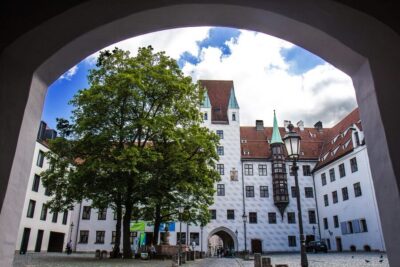
The route includes Neuhauser Tor, St. Michael’s Church, the Frauenkirche, the Town Hall courtyard, St. Peter’s Church, and the Old Town Hall.
Does the tour run in bad weather?
Yes. The tour takes place rain or shine, so dress appropriately for the forecast.
Is the walking tour wheelchair accessible?
Yes, the activity is listed as wheelchair accessible. The available information does not provide further details about conditions at individual stops.
Recently reviewed in Munich
- München: Vegetarische Viktualienmarkt-Probiertour Deutsch★ 4.8 · 6 reviews
- Wright Europe Vacations – Private Escorted Auto Tours★ 5.0 · 35 reviews
- Best of Munich Electric Bike Tour★ 5.0 · 38 reviews
- Munich Walking Quiz: Explore and Discover the City’s Highlights★ 5.0 · 7 reviews
- Walking Tour on Resistance to Nazism in Munich★ 5.0 · 8 reviews
- Private Transfer from Munich to Salzburg with 2 hours for sightseeing★ 4.5 · 13 reviews
- Private Transfer from Munich to Vienna with 2 hours for sightseeing★ 4.5 · 6 reviews
- 2 hour Sights Guided E-Scooter Tour in Munich★ 4.0 · 6 reviews
Munich Ghost & Legend Tours, compared.
Raven Black Witches and Executioners Walking Tour
Read our review →
Mystic Munich – Sagas and Legends of the Old Town
Read our review →
Ghosts of Munich: The Haunted Apprentice Exploration Game
Read our review →
Browse the lists this tour appears in