
Reviewed · MUNICH CITY HIGHLIGHTS TOURS
Best of Munich Electric Bike Tour
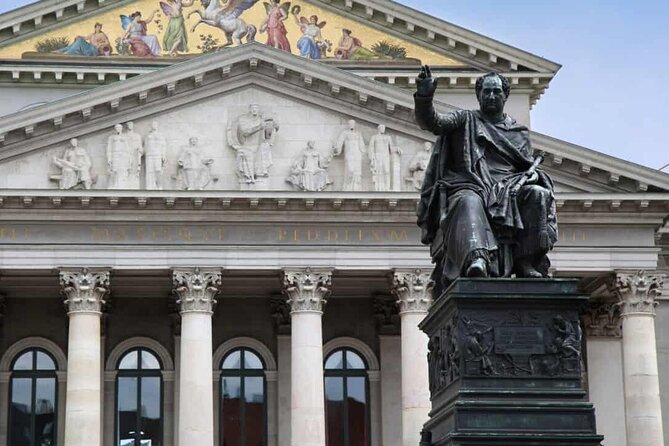
Munich reveals itself quickly from a bike. In four hours, you can roll from the Wittelsbacherbrunnen and grand neoclassical squares to the English Garden, watch river surfers at the Eisbachwelle, and finish with a beer hall stop. The wide mix of history and daily life makes this more useful than a ride limited to the Old Town.
I like the way the route joins major sights with places you might otherwise miss, including the Angel of Peace, the Maximilianeum, and Ohel Jakob Synagogue. I also like the relaxed pace and the help of an electric bike, especially when the group includes riders with different fitness levels.
The main consideration is group size. The tour can include up to 20 people, and one rider found that difficult to manage on city roads. Munich is fairly flat, so the motor is helpful but not essential for most riders.
Key points to know before you book
- The four-hour route covers far more than Munich’s central Old Town, including Königsplatz, the English Garden, the Isar, and the Deutsches Museum.
- History is the main theme, with stops connected to Bavarian royalty, the Nazi period, postwar remembrance, art, science, and Jewish life.
- The Chinesischer Turm beer garden gets about 40 minutes, but food and beer cost extra.
- Guide quality matters, and named guides such as Canaan, Susanna, Rob, Karl, Mark, and Dan have been praised for clear explanations, safety, and useful local recommendations.
- The ride is generally flat and easy, though city traffic, rain, and a large group can affect your comfort.
- The tour begins and ends at Karlsplatz 4, with a maximum group size of 20 and free cancellation up to 24 hours before departure.
Why this electric bike tour works as a first look at Munich
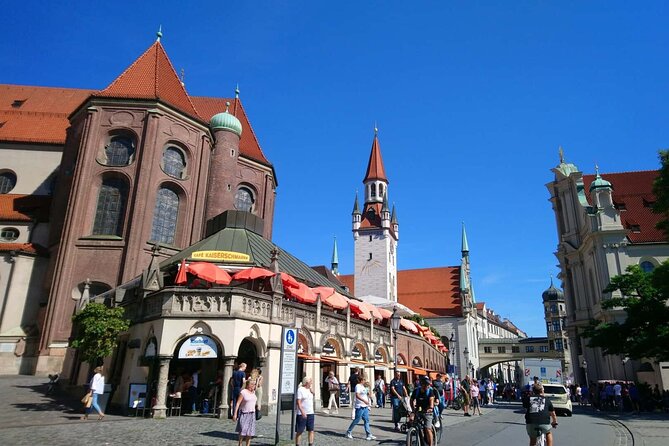
Munich is compact enough to explore on foot, but its sights are spread across several districts. A bike lets you connect the royal center, the museum quarter, the English Garden, the Isar river, and the market without spending the day waiting for trains or retracing your steps.
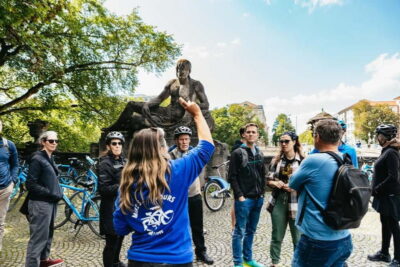
This route is not a race. The guide leads you through streets, paths, and sidewalks, with regular stops for short explanations and photographs. The electric assistance takes some work out of starting, stopping, and keeping up, although the center of Munich is mostly flat and the tour pauses often.
The strongest feature is the range of subjects. You get architecture at Königsplatz, fine art at the Pinakothek museums, difficult twentieth-century history at the Führerbau and Odeonsplatz, royal power at the Residenz, green space in the Hofgarten and English Garden, and ordinary Munich pleasures at the beer garden and Viktualienmarkt.
Guides vary by departure. Canaan has led particularly history-focused rides, while Susanna, Rob, Karl, Mark, and Dan have also been praised for friendly delivery, good pacing, safety awareness, and restaurant or museum suggestions. You should not book around one particular person unless the operator confirms your guide, but the guide can make a real difference on a route with this much material.
More bike tours in Munich:
- Munich 3-Hour Guided Bike Tour
★ 4.5 · 1,731 reviews - Classic Mike’s Bike Tour daily @ 11.30 incl Beer Garden & Surfers
★ 5.0 · 1,246 reviews - Neuschwanstein Castle by Bus Incl. Bike Ride or Hohenschwangau
★ 5.0 · 607 reviews
From Wittelsbacherbrunnen to Munich’s neoclassical heart
The meeting point is at Karlsplatz 4, a central location that is easy to reach by public transportation. After getting fitted with your electric bike and helmet, the group heads toward Wittelsbacherbrunnen, the monumental fountain at the edge of Lenbachplatz and Maximiliansplatz.
Built from 1893 to 1895 and designed by Adolf von Hildebrand, the fountain uses figures and water to represent the primal forces of nature. It is a good opening stop because it introduces Munich’s taste for grand public art before the route moves into politics, royalty, and museums.
Karolinenplatz follows. This circular square uses the Strahlenplatz, or radiating-square, design and reflects Bavaria’s early nineteenth-century ties with France. It was named for Queen Caroline of Bavaria. The stop is brief, about five minutes, but the guide can help you read the geometry of the city rather than simply pass through it.
At Königsplatz, the scale becomes more dramatic. The Propyläen Gate faces the Glyptothek and the Staatliche Antikensammlungen, creating one of Munich’s clearest neoclassical ensembles. The square sits beside the Kunstareal, Munich’s museum district, so you get a useful preview of the city’s art collections without spending hours inside a museum.
The short stop at the Führerbau changes the tone. Built between 1933 and 1937, the building was used by Adolf Hitler and remains in place today, now housing the University of Music and Performing Arts Munich. It is an important reminder that Munich’s grand avenues and institutions also carry the marks of the Nazi period.
Art, politics, and royal power around Maxvorstadt
The route then passes the Alte Pinakothek, one of the world’s oldest galleries and home to major Old Master paintings. You will have only about five minutes here, so treat it as an orientation stop, not a museum visit. If you want to see the collection, note it as a place to return after the ride.
The Pinakothek der Moderne offers a very different picture of Munich’s cultural life. Its building brings together modern and contemporary art, graphic works, design, and architecture. The contrast between the Alte Pinakothek and the modern collection helps you see that Munich is not only a city of palaces and beer halls.
At the Siegestor, a three-arched monument topped by Bavaria and a lion quadriga, the guide explains how public symbols can change meaning. It was first dedicated to the glory of the Bavarian army. After restoration following World War II, it became a reminder of peace. That shift gives the stop more weight than a simple photograph at a triumphal arch.
Odeonsplatz is one of the most important history stops. Developed in the early nineteenth century, the square leads toward Ludwigstraße, the Theatine Church, the Feldherrnhalle, and the former Odeon concert hall. It was also the scene of a deadly clash that ended the 1923 Beer Hall Putsch. The short visit cannot cover every detail, but a good guide gives you enough context to understand why this polished square matters.
The Residenz, former home of Bavaria’s Wittelsbach monarchs, is another place you may want to revisit. It is Germany’s largest city palace, with decorated rooms, architecture, and royal collections. The tour stops outside for orientation rather than taking you through the interiors.
Next comes the Hofgarten, laid out between 1613 and 1617 in the style of an Italian Renaissance garden. Its central Diana pavilion provides a calmer setting after the political weight of Odeonsplatz. Nearby, the Bavarian State Chancellery wraps around the dome of the former Bavarian Army Museum. The present building was created between 1989 and 1993, giving the route another example of Munich rebuilding and adapting old structures.
The English Garden and the Chinesischer Turm beer stop
The English Garden is where the ride feels less like a city tour and more like a local outing. At 370 hectares, it is one of the world’s largest urban public parks. Its informal design follows the English garden style, with open green areas, paths, trees, and water.
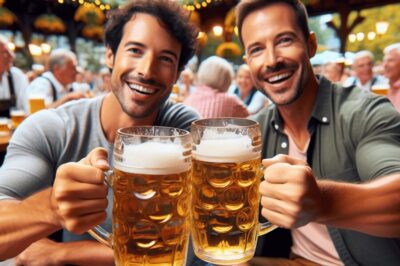
You get about ten minutes in the park before reaching the Biergarten am Chinesischen Turm. The beer garden has around 7,000 seats and has operated under the same management since 1974. It serves Hofbräu beer and is one of Munich’s best-known outdoor beer spots.
The scheduled 40-minute pause is a genuine advantage. You can buy a traditional German beer or food, sit at shared tables, and enjoy the social side of Bavarian dining. Food and drinks are not included, so budget separately. This is not a formal tasting, and the price does not cover your order. It is simply time built into the ride for a classic Munich stop.
I like this break because it keeps the tour from becoming a nonstop string of monuments. The tradeoff is that your experience depends partly on weather and crowd levels. If you prefer museums or quiet restaurants, the beer garden may feel touristy. If you want a taste of Munich’s public social life, it is one of the route’s most useful stops.
More first-day tours of Munich:
- Munich: Big Bus Hop-On Hop-Off Sightseeing Bus Tour
★ 4.0 · 842 reviews - Munich: Classic Guided City Tour by Bike (English Tour Only)
★ 4.7 · 534 reviews - Munich Private Tour with a Local – Highlights & Hidden Gems
★ 5.0 · 469 reviews - Munich: City Highlights Guided Segway Tour
★ 4.6 · 266 reviews
River surfing, peace monuments, and the Isar
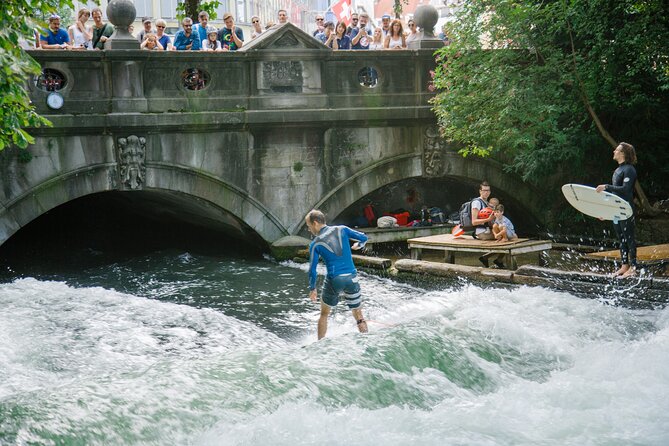
After the beer garden, the ride heads to the Eisbachwelle near the Haus der Kunst. The river forms a standing wave about one meter high, attracting experienced surfers. The water is cold and shallow, sometimes only 40 centimeters deep, so this is a viewing stop rather than an invitation to try it.
The Eisbachwelle is a fine example of Munich’s character: formal museums and royal avenues sit close to a strange, energetic outdoor sport. Ten minutes is enough to see the wave and watch the surfers if conditions are active.
The Angel of Peace, or Friedensengel, provides another change of mood. The monument sits above the Isar at the eastern end of Prinzregentenstrasse. A 38-meter Corinthian column carries a six-meter statue modeled on the Nike of Paeonius. The open space, fountain, and river views make this one of the more scenic pauses on the route.
Nearby, the Maximilianeum houses the Bavarian State Parliament. It was originally built as a foundation for gifted students and has served as the parliament’s home since 1949. The grand building helps explain Munich’s nineteenth-century ambition, but the stop is short and mainly exterior.
The Deutsches Museum is the final major museum reference on the ride. It is the world’s largest museum of science and technology, with about 125,000 objects covering 50 fields. Five minutes cannot do it justice, but the guide can help you decide if it deserves a separate visit.
Markets, memory, and the last Old Town stops
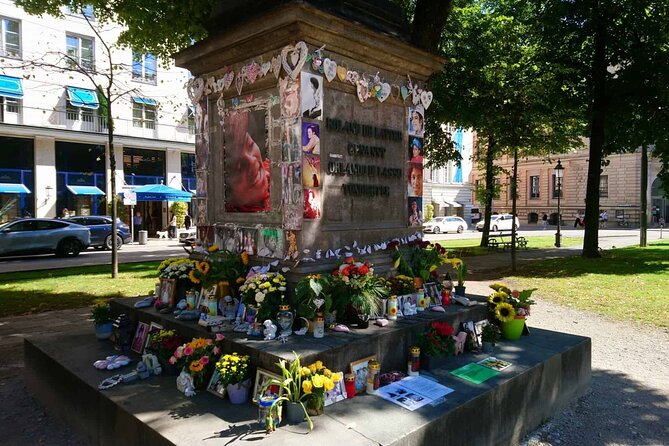
The Viktualienmarkt is a compact lesson in Munich’s food culture. What began as a farmers’ market now includes around 140 stalls and shops selling flowers, fruit, game, poultry, spices, cheese, fish, and juices. The five-minute visit is enough to get your bearings, but you will want to return if you like browsing food markets.
Ohel Jakob Synagogue brings a more recent and serious chapter to the route. Built between 2004 and 2006 as Munich’s main synagogue, it was inaugurated on November 9, 2006, the sixty-eighth anniversary of Kristallnacht. The stop gives the tour a needed connection to contemporary Jewish life and to the city’s effort to remember its past.
The route then returns to Karlsplatz. Since the tour is scheduled for about four hours, the total time includes cycling, traffic, stops, explanations, and the beer garden break. The published stop times add up to roughly two hours, so you should expect the rest of the time to be spent moving between districts and gathering the group.
What the $71.90 price buys you
At $71.90 per person, the tour is not the cheapest way to see Munich. But the value is reasonable if you want a planned route, an English-speaking guide, an electric bike, a helmet, and a broad introduction in one half-day.
You are paying less for entry tickets than for organization and interpretation. The listed stops do not include admission to the Residenz, Alte Pinakothek, Pinakothek der Moderne, or Deutsches Museum. That is sensible for a first look, since entering even one major museum would change the timing and add cost.
The electric bike is helpful for keeping the group together, especially in cool weather or if you are not used to cycling several hours. Several riders found the motor unnecessary because Munich is flat and the ride is broken up by frequent stops. If the booking is shared with standard bicycles, check exactly what your reservation includes, since the group may contain both bike types.
Who will enjoy the ride, and who may not
This is a strong choice for history buffs, first-time visitors, families with older children, and anyone who wants a quick sense of Munich before choosing which places deserve a longer visit. A family with teenage boys found the ride easy to enjoy, and the route’s mix of museums, gardens, monuments, and food keeps it from feeling like a lecture.
You should be reasonably comfortable on a bike and able to manage a ride lasting roughly three and a half to four hours. The route is described as flat and suitable for all riding levels, but city riding still requires attention. One rider found a 20-person group too large for a single guide to oversee comfortably on busy roads.
Weather is another practical concern. The ride can go ahead in rain or cold, but wet roads and uncomfortable hands can reduce the fun. Wear clothing suited to the forecast and remember that the beer garden stop is outdoors.
The tour is offered in English and includes a live guide. Confirmation arrives when you book, and the activity begins and ends at Karlsplatz 4. Most people can participate, but the supplied details do not promise adapted equipment or a specific accessibility arrangement, so ask the operator if you have mobility concerns.
Should you book the Best of Munich Electric Bike Tour?
Book it if you want one guided ride that links Munich’s art, royal, Nazi-era, Jewish, park, river, and beer culture. The route is broad, the city is easy to cycle, and the guide’s local suggestions can help shape the rest of your stay.
Skip it if you prefer slow museum visits, dislike riding in traffic, or want a small private group. The maximum of 20 people is manageable for some groups but can feel crowded for others. At $71.90, the tour earns its price through coverage and guidance rather than included admissions or food.
For most first visits, I would book it early in the stay. Use the ride to mark places for a return visit, then spend another day inside the Residenz, a Pinakothek, the Deutsches Museum, or the Viktualienmarkt. Cancel at least 24 hours before departure if your plans change, since later cancellations and changes are not refundable.
FAQ
How long does the Best of Munich Electric Bike Tour last?
The tour lasts approximately four hours, though some descriptions and timing references place the ride closer to three and a half hours.
Where does the tour start and finish?
It starts at Karlsplatz 4, 80335 Munich, Germany, and returns to the same meeting point.
Is an electric bike included?
Yes. The experience includes an electric bike and helmet. The group may also include people riding standard bicycles.
Is the tour offered in English?
Yes. The tour is offered in English and includes a live guide.
Are food and drinks included?
No. Food and drinks are not included. The tour allows about 40 minutes at the Biergarten am Chinesischen Turm, where you can buy beer and food separately.
Does the tour enter the museums and palaces?
The route stops at or near the Alte Pinakothek, Pinakothek der Moderne, Residenz München, and Deutsches Museum, but admission tickets are not included in the tour details.
How large can the group be?
The maximum group size is 20 people.
Can I cancel for a full refund?
Yes, if you cancel at least 24 hours before the experience start time. Cancellations or changes made less than 24 hours before departure are not accepted for a refund.
Recently reviewed in Munich
- München: Vegetarische Viktualienmarkt-Probiertour Deutsch★ 4.8 · 6 reviews
- Wright Europe Vacations – Private Escorted Auto Tours★ 5.0 · 35 reviews
- Munich Walking Quiz: Explore and Discover the City’s Highlights★ 5.0 · 7 reviews
- Walking Tour on Resistance to Nazism in Munich★ 5.0 · 8 reviews
- Private Transfer from Munich to Salzburg with 2 hours for sightseeing★ 4.5 · 13 reviews
- Private Transfer from Munich to Vienna with 2 hours for sightseeing★ 4.5 · 6 reviews
- 2 hour Sights Guided E-Scooter Tour in Munich★ 4.0 · 6 reviews
- From Munich: Neuschwanstein Castle and Linderhof Private Tour★ 5.0 · 13 reviews
Munich City Highlights Tours, compared.
Classic Guided City Tour by Bike (English Tour Only)
Read our review →
Munich Private Tour with a Local – Highlights & Hidden Gems
Read our review →
City Pass 45+ Top Attractions and Public Transport
Read our review →
Munich Premium Sightseeing Hopping and Traditional Bavarian Delicacies
Read our review →Browse the lists this tour appears in