
Reviewed · MUNICH OLD TOWN WALKING TOURS
Ten Munich Old town Sights in a Private Express Walking Tour
Munich’s old town is compact, but its stories are not. On this private walk, Victoria leads you from the Old Town Hall to Hofbräuhaus, linking salt traders, medieval fortifications, royal monkeys, execution bells, a devil’s footprint, and the city’s famous beer culture. It is a fast, story-filled introduction to Munich.
I like the private format, since your group can ask questions and set a comfortable pace. I also like the clever use of an iPad to show how wartime damage changed Munich’s buildings, a useful touch if you want more than pretty façades. The main drawback is time: 90 minutes is enough for a well-chosen overview, not a slow visit to every interior or museum.
- Victoria’s personal guiding style: Expect a warm, fluent English-speaking guide who has helped families adjust the pace and make practical stops when needed.
- Ten sharply chosen sights: The route covers Munich’s main square, oldest church, cathedral, royal courtyards, former royal mill, and Hofbräuhaus.
- Stories you can actually remember: Look for the Poor Sinners’ bell, the Monkey Tower, the Devil’s footprint, and the traditions at Fischbrunnen.
- A useful visual aid: Victoria uses an iPad to show historic images, including the effect of the war on Munich’s buildings.
- Good ending point: The tour finishes inside Hofbräuhaus, close to Marienplatz and within easy reach of the rest of the old town.
- A quick orientation with local advice: You receive suggestions for restaurants, shopping, and sights to visit after the walk.
Munich in 90 minutes, with a story at every turn
This tour works because it does not treat Munich’s old town as a row of grand buildings with dates attached. Each stop has a small hook. A fountain becomes a place for washing wallets. A church tower has eight clocks. A courtyard points to a royal scandal involving a monkey.
Victoria is the guide named for this experience, and the tour is offered in English. Her approach combines historical explanation with visual material on an iPad. That matters in Munich, where many old buildings were damaged during the war and later rebuilt. A historic photograph can help you see what restoration changed.
The tour is private, so only your group takes part. That gives you a better chance to ask why a symbol matters, pause for a family member, or clarify a detail without holding up a larger party. A family with two young children found Victoria willing to help with a bathroom break and adjust the pace, which suggests that this is not a rigid, lecture-style walk.
You should still keep your expectations sensible. The listed stops add up to about 90 minutes, and several receive only five or ten minutes. You will see and discuss many places, but you will not have time for a full church visit, a museum, a beer tasting, or a long meal.
Starting beside the Old Town Hall
Meet at the Toy Museum Munich, at Marienplatz 15, by the tower of the Old Town Hall. This is a practical meeting point in the center of Munich, close to public transportation and easy to find once you are in the square.
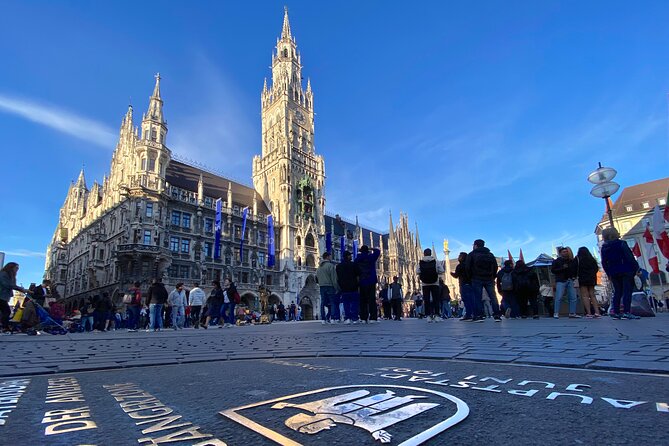
The Old Town Hall gives Victoria a good opening chapter. You learn how the building fit into Munich’s medieval fortifications, how the city was founded, and how salt helped the settlement grow into the Bavarian capital. Salt was not just a seasoning. It was a valuable trade product, and control of its movement helped bring money and power to the city.
You also hear why a monk became Munich’s symbol and how that story connects with the city’s name. This opening is brief, only about five minutes, but it gives you the basic frame for the rest of the walk: trade, religion, civic power, and local legends.
More walks through the old town:
- Munich: Old Town & Viktualienmarkt City Walk in German
★ 4.7 · 2,304 reviews - Munich Old Town Walking Tour
★ 4.5 · 1,287 reviews - Munich: Spooky Tour of Old Town in German
★ 4.6 · 1,112 reviews
St. Peter’s Church and the silent execution bell
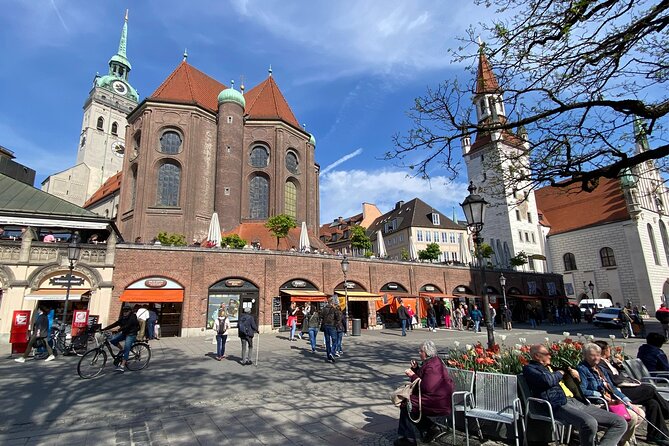
St. Peter’s Church is Munich’s oldest church, and the outside already gives you several things to look for. Its tower is decorated with eight clocks, an unusual detail that is easy to miss if you are simply hurrying toward Marienplatz.
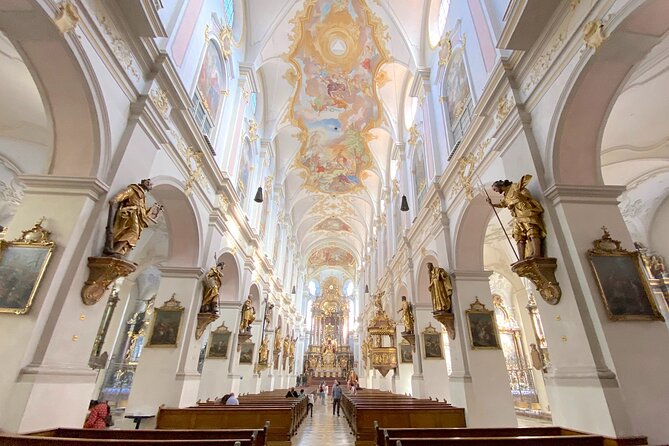
Inside, the high altar features St. Peter. Victoria explains when his tiara is removed and how that symbolic act relates to the election of a pope in Rome. It is the kind of small ceremonial detail that makes a church feel connected to wider European traditions.
Back outside, look for a cannonball in one of the windowsills. You will also see the Poor Sinners’ bell, the only bell at St. Peter’s that is presently silent. In earlier times, it tolled for executions held on Marienplatz. That is a darker story than the usual sightseeing script, but it helps you understand how the square once served very different purposes.
The stop lasts about ten minutes. If you want to climb the tower or study the interior in detail, you will need to return on your own. The tour is designed to point out meaning, not provide an extended church visit.
Marienplatz, Munich’s public stage
Marienplatz is Munich’s central square and the main stage of the old town. Victoria explains how it began as the medieval city’s marketplace and remains the center of daily city life.
You will examine the column of St. Mary, including the angels fighting the four evils at its base. You will also learn how to read Munich’s driving distances and where the Munich white sausage was invented. These details turn the square into more than a photo stop. You start noticing how religion, food, transport, and civic pride share the same space.
Ten minutes goes quickly here, especially when the square is busy. The private format helps because you can ask a quick follow-up question instead of waiting for a whole group to gather. Still, this is a place where you may want to linger after the tour and watch the city move around you.
Fischbrunnen and two old Munich customs
Fischbrunnen, or the Fish Fountain, is one of Munich’s best-known fountains. The stop lasts only five minutes, but it introduces two local customs: Wallet Washing and the Butchers’ Jump.
The first connects the fountain with prosperity and the hope of keeping money in your wallet. The second recalls a traditional butchers’ celebration. These customs show the practical, communal side of old Munich, where trades and public rituals shaped the city’s identity.
This is also a good place to ask Victoria for a quick orientation to nearby cafés or restaurants. Food and drinks are not included, but restaurant suggestions are part of the guide’s local advice.
More first-day tours of Munich:
- Munich: Big Bus Hop-On Hop-Off Sightseeing Bus Tour
★ 4.0 · 842 reviews - Munich: Classic Guided City Tour by Bike (English Tour Only)
★ 4.7 · 534 reviews - Munich Private Tour with a Local – Highlights & Hidden Gems
★ 5.0 · 469 reviews - Munich: City Highlights Guided Segway Tour
★ 4.6 · 266 reviews
The New Town Hall and its famous clock
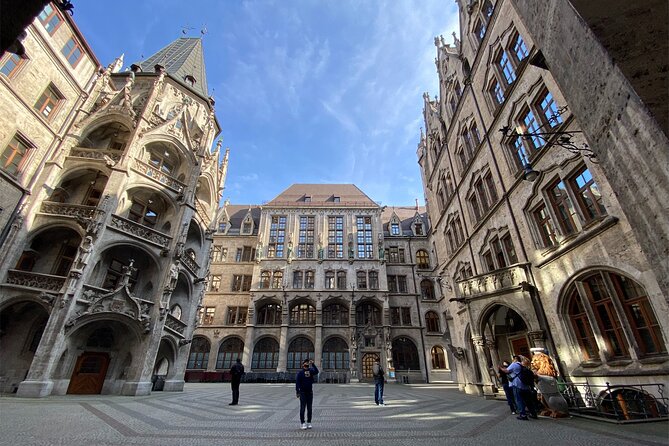
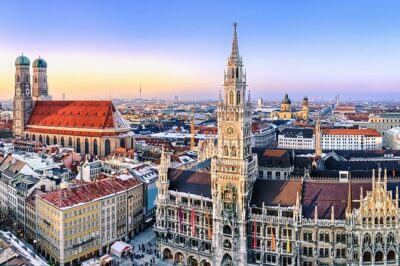
The New Town Hall is one of Munich’s most recognizable buildings. Victoria explains its Neo-Gothic design and helps you read the structure rather than simply admire its height and decoration.
The big attraction is the Glockenspiel, the mechanical clock that reenacts two important moments in Munich’s past. The figures move to different carillon tunes, giving the building a small daily theater. If you are planning around a clock performance, confirm the timing when you book, since the tour itself is scheduled for about 90 minutes and the exact start time is not provided here.
You visit the New Town Hall twice. The first stop focuses on the exterior and the Glockenspiel. Later, you look into its courtyard and examine the details that are easy to miss from the square.
Frauenkirche and the Devil’s footprint
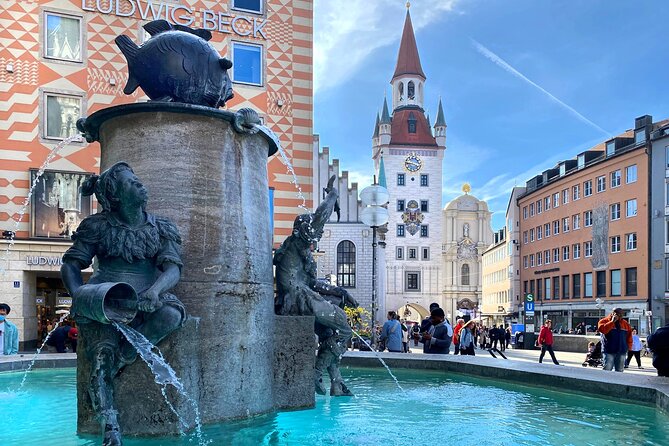
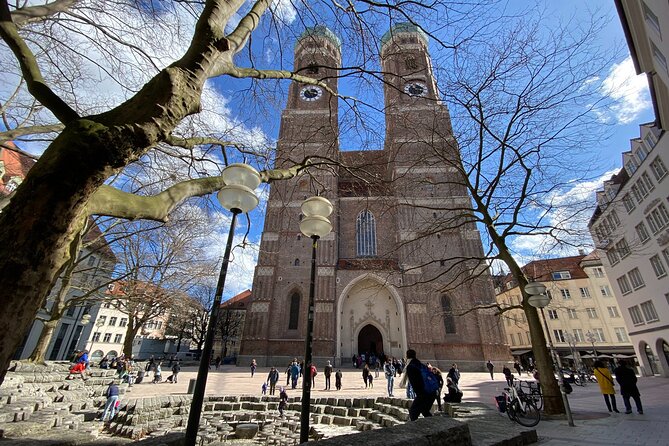
Munich’s cathedral, the Frauenkirche, brings the tour into the realm of legend. Victoria tells the unsettling story of its construction and points out the Devil’s footprint near the entrance.
The story is tied to the wind that seems to blow around the cathedral regardless of the season or weather. It is a memorable bit of local folklore, and the physical footprint gives you something concrete to look for rather than a tale that floats away as soon as it is told.
The stop takes about 15 minutes, the longest on the route. That gives you time to consider the exterior and the interior features described during the visit. As with St. Peter’s, do not assume this replaces a full independent visit if you want quiet time, extended prayer, or close study of the cathedral.
The New Town Hall courtyard and the Staircase of Ages
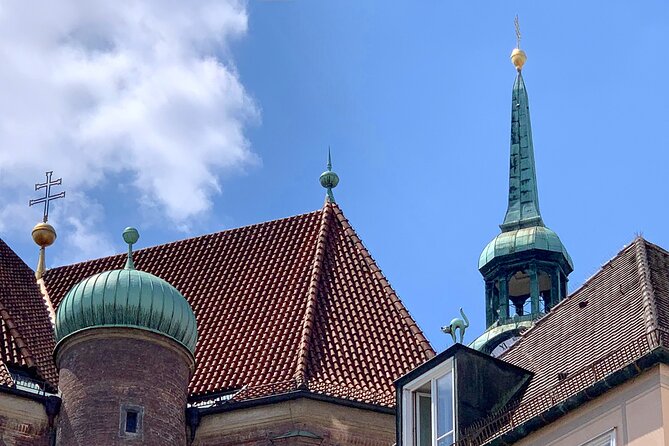
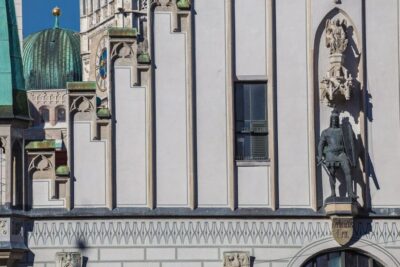
The second New Town Hall stop moves away from the square and into the grand courtyard. Here, Victoria explains the symbolism behind the sculptures on the portico of the old city treasury.
You will also see the Staircase of Ages and learn how the statues on its walls express a larger idea of time and civic history. This is one of the tour’s more useful design-focused moments. From the outside, the New Town Hall can seem like one enormous decorative wall. In the courtyard, you get a better sense of how its spaces and symbols were planned.
The stop is only five minutes, so listen closely and ask questions while you are there. If architecture interests you, this short visit may leave you wanting to return for another look.
Alter Hof and the royal Monkey Tower
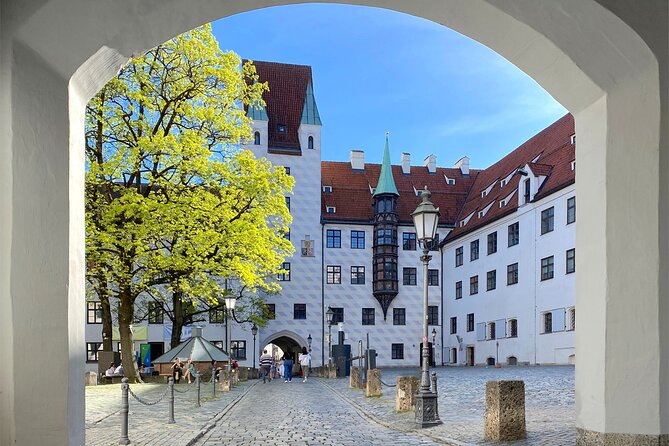
Alter Hof was the first Munich residence of the Wittelsbach royal family. Its inner courtyard is a quieter change from the open squares and large churches earlier in the walk.
The main curiosity is the Monkey Tower. Victoria explains its legend and its surprising role in the life of Holy Roman Emperor Louis IV. This is exactly the sort of odd detail that helps you remember a place long after you have forgotten a list of dates.
The courtyard stop lasts about ten minutes. It also gives your group a chance to slow down and take in the change from public civic space to royal residence. You are not just moving between famous landmarks. You are tracing how power shifted among the city council, the church, and the ruling family.
Pfistermühle and the pretzel connection
At Restaurant Pfistermühle, you pass the building that once held the royal mill and bakery. Victoria connects the site with the legend of the pretzel and explains its symbolic link to Munich.
This stop takes five minutes, so it is best understood as a story attached to a building rather than a bakery visit. You will not receive food as part of the experience, and the tour does not include tastings. If pretzels are on your Munich list, you can use the guide’s later restaurant and food suggestions to plan where to eat.
Hofbräuhaus, ending with beer culture
The walk ends at Hofbräuhaus München, Munich’s former royal brewery and most famous beer hall. You go inside the main hall for about 15 minutes.
Victoria points out the beer angel, the regular customers at their tables, and the lockers used to store personal beer mugs. That last detail gives you a glimpse of beer hall life as a local habit, not just a tourist photo opportunity.
You also learn about the beer purity law, which breweries may sell beer at Oktoberfest, and the unexpected connection between Oktoberfest and a royal wedding. There is no beer tasting included, so plan to order a drink or a meal separately if you want the full beer hall experience.
Ending here is convenient. Hofbräuhaus is at Platzl 9, only a short walk from Marienplatz. You can continue with lunch, dinner, a drink, or another look around the square without having to find your way back to a distant meeting point.
What the $84.29 price means
At $84.29 per person, this is not the cheapest way to stroll through Munich. You can walk between these landmarks on your own for free, and the churches, courtyards, and public squares do not carry an admission charge as part of this experience.
The value comes from the private guide and the amount of interpretation packed into 90 minutes. You are paying to connect the places, understand the symbols, hear the local legends, and get recommendations for restaurants, shopping, and sights. For a first visit, that can save time and prevent the old town from becoming a blur of similar façades.
The price is easier to justify for a couple, family, or small group that wants personal attention. Group discounts are available, though the exact discount is not specified. Solo visitors should weigh the cost more carefully, since the private format cannot spread the guide fee across a large shared group.
The tour is often booked about 96 days in advance, so planning early makes sense if you want a particular date. Confirmation arrives at booking, and cancellation is free up to 24 hours before the start time. Changes or cancellations inside that window are not accepted for a refund.
Who will get the most from this walk
I would choose this tour for a first visit to Munich, especially if you want the old town explained in plain language rather than simply photographed. It also suits repeat visitors who have seen Marienplatz before but want the stories behind the buildings.
Families may appreciate the private pace and the guide’s willingness to help with practical needs. Victoria’s use of an iPad should also help children and adults picture the city before and after wartime damage.
This is a good fit if you like folklore, architecture, food traditions, and royal stories. It is less suitable if your main goal is a long church visit, a museum interior, a tower climb, or beer sampling. The route is packed, and the short stops favor variety over depth.
Practical details before you book
The tour starts by the Old Town Hall at Toy Museum Munich, Marienplatz 15, and ends at Hofbräuhaus, Platzl 9. Both points are in central Munich, and the route is near public transportation.
It is offered in English and includes a private, fluent guide. Service animals are allowed, and most people can take part. Since the walk covers several old town streets and courtyards, wear comfortable shoes and arrive ready to keep moving, though those practical suggestions are not formal requirements stated for the tour.
Food and drinks are not included. Set aside extra time after the walk if you want to eat at Hofbräuhaus or explore the surrounding restaurants.
Should you book the Key to Munich walk?
Book it if you want a concentrated introduction to Munich with a private guide who can answer questions, adjust the pace, and explain the odd details that make the city memorable. Victoria’s friendly manner, family awareness, restaurant advice, and iPad images add real value to a short route.
Skip it if you prefer to wander alone, spend an hour inside each church, or keep sightseeing costs to a minimum. At $84.29 per person, the tour is a paid orientation rather than a bargain attraction. For a first day in Munich, though, the route gives you a clear map of the old town and plenty of ideas for what to do next.
FAQ
How long is the Munich old town walking tour?
The tour lasts approximately 1 hour and 30 minutes.
Where does the tour start?
It starts at Toy Museum Munich, Marienplatz 15, 80331 München, by the Old Town Hall tower.
Where does the tour end?
It ends at Hofbräuhaus München, Platzl 9, 80331 München, inside or at the famous beer hall area described for the tour. The site is a short walk from Marienplatz.
Is this a private tour?
Yes. Only your group participates in the activity.
Is the tour offered in English?
Yes. The tour is offered in English, with a fluent guide.
Is food or beer included?
No. Food and drinks are not included, and there is no beer tasting.
Is the tour suitable for families?
Most people can participate, and service animals are allowed. The private format can suit families because the pace can be adjusted, and Victoria has helped families with practical breaks during the walk.
What is the cancellation policy?
You can cancel for a full refund up to 24 hours before the experience start time. Cancellations or changes made less than 24 hours before the start are not accepted for a refund.
Recently reviewed in Munich
- München: Vegetarische Viktualienmarkt-Probiertour Deutsch★ 4.8 · 6 reviews
- Wright Europe Vacations – Private Escorted Auto Tours★ 5.0 · 35 reviews
- Best of Munich Electric Bike Tour★ 5.0 · 38 reviews
- Munich Walking Quiz: Explore and Discover the City’s Highlights★ 5.0 · 7 reviews
- Walking Tour on Resistance to Nazism in Munich★ 5.0 · 8 reviews
- Private Transfer from Munich to Salzburg with 2 hours for sightseeing★ 4.5 · 13 reviews
- Private Transfer from Munich to Vienna with 2 hours for sightseeing★ 4.5 · 6 reviews
- From Munich: Neuschwanstein Castle and Linderhof Private Tour★ 5.0 · 13 reviews
Munich Old Town Walking Tours, compared.
Mystic Munich – Sagas and Legends of the Old Town
Read our review →
Fall in Love with Munich in a Private Old Town Walking Tour
Read our review →
Browse the lists this tour appears in