
Reviewed · MUNICH OLD TOWN WALKING TOURS
Fall in Love with Munich in a Private Old Town Walking Tour
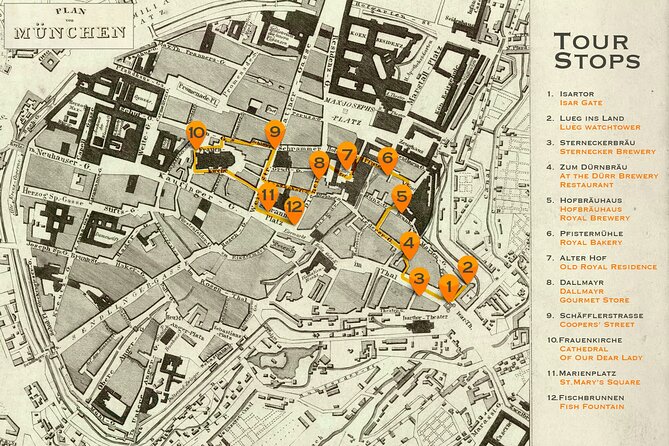
Munich’s past comes in layers, and this two-hour walk puts many of them side by side. You’ll begin at Isartor, one of the old city gates, then move through royal courtyards, beer halls, Nazi-era sites, a cathedral, and the grand square at Marienplatz. Guide Victoria uses stories, maps, and images on her iPad to make the city’s changing face easier to understand.
I like the private format, especially for families or groups with different walking speeds. I also like the useful local advice built into the tour, from restaurants and coffee to museums and beer halls. The main consideration is time: two hours gives you a sharp introduction, but stops are brief and most places are viewed from outside or visited only in part.
Key points to know before booking
- Private for up to six people: Your group gets Victoria’s full attention rather than sharing a guide with strangers.
- A strong first-day tour: The route ends at Marienplatz, giving you a clear sense of where to explore next.
- History with unusual details: Expect stories about Munich’s salt trade, the Devil’s footprint, the invention of white sausage, and the city’s famous cooper dance.
- Inside Hofbräuhaus and Frauenkirche: These are not just photo stops. You’ll hear how beer, religion, royal power, and local custom shaped Munich.
- Useful recommendations: Victoria gives suggestions for food, coffee, beer, shopping, museums, and further sights.
- Good value for a small group: At $157.28 for up to six people, the per-person cost drops sharply when your group is full.
Starting at Isartor and meeting medieval Munich
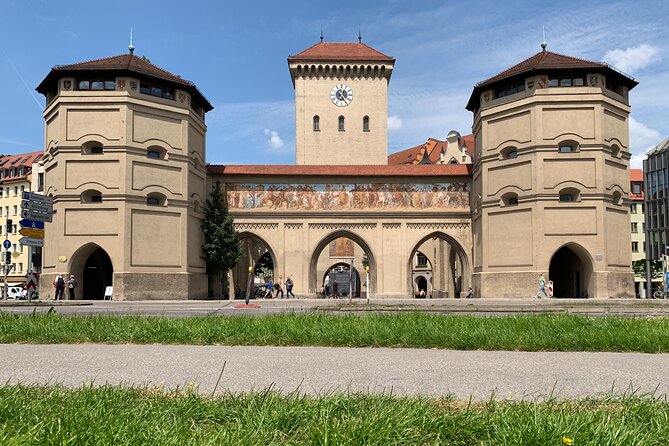
The tour starts beneath the central arch of Isartor at Tal 50. This is a smart meeting point because the gate immediately gives you a physical sense of medieval Munich. Instead of beginning with a broad square full of modern traffic, you start beside the old defenses that once marked the city’s edge.
Victoria explains the remains of the medieval wall and the legend behind Munich’s foundation. She also connects the city’s growth to the trade in a single product: salt. That detail helps explain how Munich moved from a settlement into an important commercial center.
There is plenty of local color here. You’ll hear about Munich’s best-loved comedian, whose museum occupies the gate towers, and the curious Bavarian idea that clocks run backward. These details keep the opening from becoming a list of dates.
The stop lasts about 15 minutes and has no admission charge. Since the route is outdoors, you’ll want comfortable shoes and clothing suited to the weather. The walk is described as being at a comfortable pace, and Victoria has adjusted timing for groups with young children, grandparents, travel delays, and different walking needs.
More walks through the old town:
- Munich: Old Town & Viktualienmarkt City Walk in German
★ 4.7 · 2,304 reviews - Munich Old Town Walking Tour
★ 4.5 · 1,287 reviews - Munich: Spooky Tour of Old Town in German
★ 4.6 · 1,112 reviews
A difficult chapter at Sterneckerbräu
From Isartor, the walk turns toward Sterneckerbräu. This stop deals with Adolf Hitler’s first public speech at the site and the building’s later connection to the Nazi Party. It is a short stop, about 10 minutes, but it adds an important political layer to the tour.
Munich is often sold through images of beer halls, royal buildings, and tidy squares. That picture is incomplete. A good city tour needs to explain how the same streets also became settings for political movements that changed Germany and Europe. Here, Victoria places the building within that wider story without letting the subject take over the whole walk.
This is not a museum visit, and you should not expect a long treatment of World War II. Instead, it is a concise historical marker within a broader tour. If you want an extended focus on the Nazi period, you’ll need a separate experience.
Dürnbräugasse and the oldest tavern story
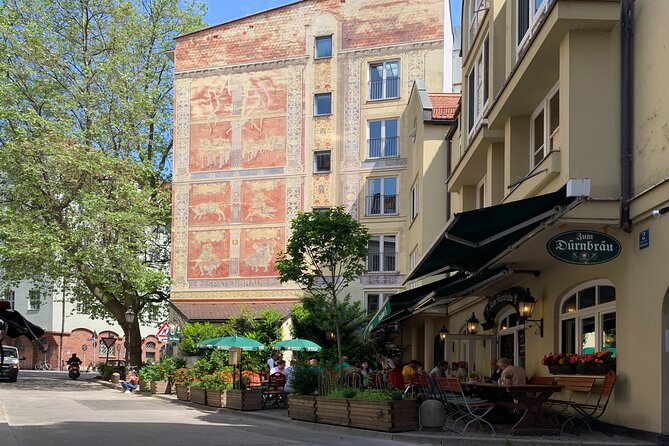
The next stop is Dürnbräugasse, where you pass Munich’s oldest tavern. The visit takes only about five minutes, but it gives you a chance to consider how eating and drinking have shaped the old town for centuries.
Victoria explains the tavern’s resilience and how it preserved its claim to be the city’s oldest for more than 500 years. This is the kind of small story that helps you read Munich’s streets differently. You are not simply walking past an old building. You are seeing a place tied to continuity, business, and local custom.
The short timing also tells you what this tour is designed to do. It samples many stories rather than spending half an hour at every address.
Hofbräuhaus, beer culture, and the royal brewery
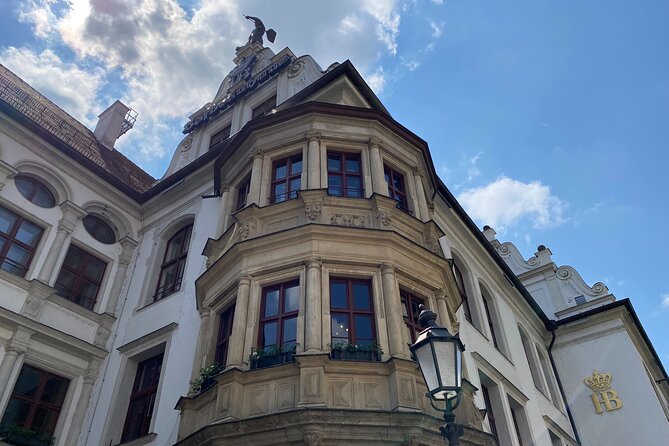
Hofbräuhaus gets about 20 minutes, making it one of the longer stops. You go inside the main hall of the former royal brewery and learn how the building became the world’s best-known beer hall.
Victoria points out the regulars’ tables and the special cells where some regular customers keep their personal beer mugs. You’ll also hear about the Bavarian brewing tradition, the beer purity law, Oktoberfest, and the difference between a beer hall and a beer garden.
This part should be especially useful if you are visiting during Oktoberfest or planning to spend an evening in a beer hall. The tour gives you cultural context before you order a Maß, rather than presenting beer as a simple tourist prop.
The visit is free, but food and drinks are not included. That is a benefit in one sense: you are not forced into a meal during a tight walking schedule. You can return later if you want more time to eat, drink, or watch the room at its busiest.
Do not expect a full beer tasting. This is an architectural and historical visit, with practical advice about Bavarian drinking customs. For many people, that is the better use of a short city tour.
Same city, a very different afternoon:
- From Munich: Neuschwanstein & Linderhof Castle Full-Day Trip
★ 4.5 · 12,494 reviews - Neuschwanstein & Linderhof Castle-Fairytale Day Tour from Munich
★ 4.5 · 7,275 reviews - Munich: Third Reich & WWII Walking Tour
★ 4.6 · 6,181 reviews - Dachau Concentration Camp Memorial Site Tour from Munich by Train
★ 4.5 · 5,637 reviews
The pretzel legend at Pfistermühle
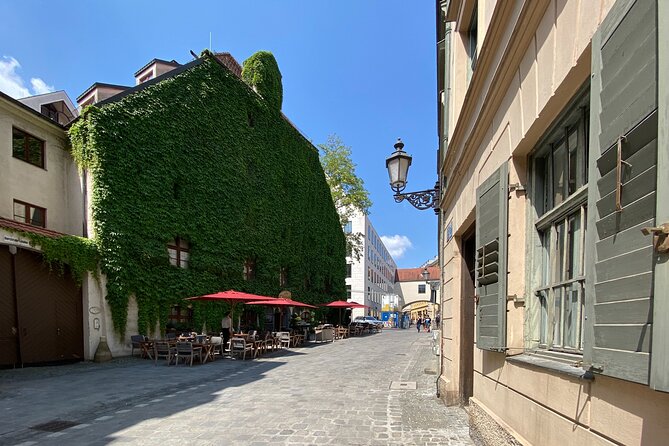
At Restaurant Pfistermühle, you see the former royal bakery and hear the legend of the pretzel. The story also explains the pretzel’s symbolic link to Munich.
This is a quick 10-minute stop, but it adds a food angle to the route. Along with the later visit to Dallmayr and the white sausage story at Marienplatz, it helps connect Munich’s history to things you can actually eat during your stay.
You will not receive food here, and meals are not part of the price. Think of this as a story stop with a useful result: you begin to understand why certain foods matter locally.
Alter Hof and the Wittelsbach rulers
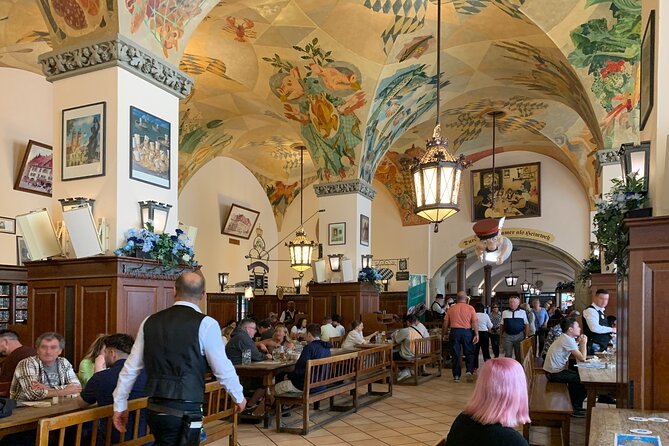
At Alter Hof, the group enters the inner courtyard of the first Munich residence of the Wittelsbach royal family. The courtyard gives you a quieter architectural break from the main streets and a chance to consider how Munich grew around dynastic power.
Victoria tells the legend of the Royal Zoo and its unexpected role in the life of Holy Roman Emperor Louis IV. She also explains how Munich’s flag acquired its colors. These are small details, but they do the work of turning a royal residence into a human story.
This stop lasts about 10 minutes. The courtyard setting may appeal to you if you like architecture but do not want a tour made only of building dates. The guide’s use of visuals can also help you picture earlier versions of places that have changed over time.
Dallmayr and Munich’s food culture
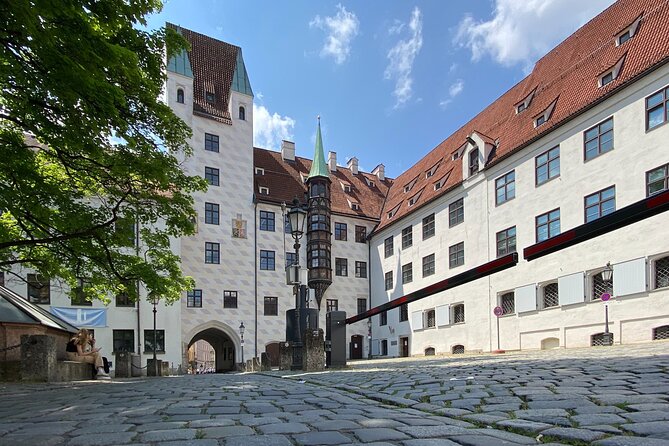
Dallmayr Delikatessenhaus is a quick five-minute stop outside one of Europe’s major delicatessen companies. The business has a longstanding royal connection, and Victoria shares curious details from its past.
The practical value comes in her food and coffee suggestions. Several parts of the experience focus on what to do after the tour, and this is one of the clearest examples. If you care about coffee, sweets, gourmet food, or a well-chosen place to eat, make a note of her advice.
Because the stop is brief, you should not expect time to shop here as part of the guided walk. The useful approach is to return later, once you know what interests you.
Schäfflerstraße and the dance after the plague
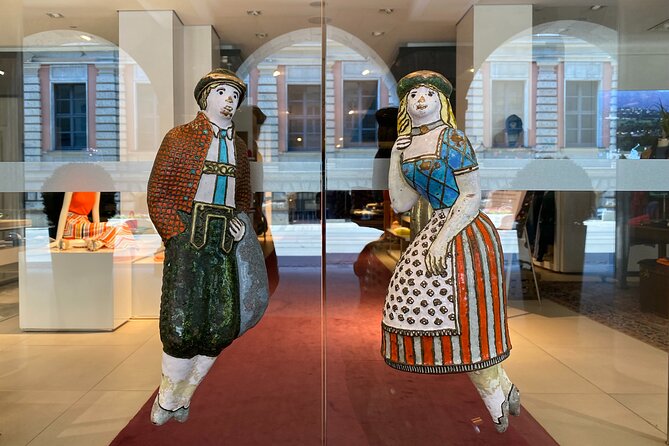
On Schäfflerstraße, also called Coopers’ Street, you hear Munich’s best-known legend about the traditional dance linked to the end of a 16th-century plague outbreak. The dance is still performed in the Bavarian capital.
This is another five-minute stop, but it gives you a glimpse of civic memory. Munich’s traditions are not all tied to palaces or churches. Some live through trades, public celebrations, and stories repeated across generations.
The stop works well for families because it is easy to picture and has a clear narrative. It also breaks up the heavier material about Nazi history and royal politics.
Frauenkirche, the Devil’s footprint, and the wind
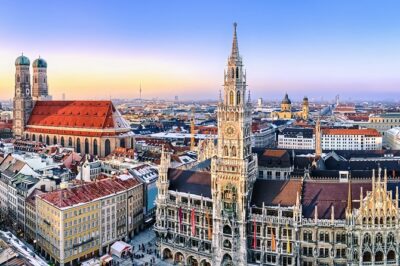
Frauenkirche receives about 20 minutes. You visit Munich’s cathedral and hear the legend of its construction, then connect that story to the church’s unusual interior.
Victoria points out the Devil’s footprint and explains the mystery of the wind that circles the cathedral throughout the year, regardless of season. These tales give the building a sense of place beyond its formal religious and architectural importance.
This is one of the tour’s more memorable stops if you enjoy legends tied to real buildings. You are not only looking at a famous church. You are learning how local stories explain features that might otherwise seem odd or easy to miss.
The tour does not promise a full architectural lecture or a long religious visit. The 20-minute timing is enough for orientation, a few key details, and the chance to look around without losing the route’s momentum.
Marienplatz and Munich’s clockwork finale
The walk finishes at Marienplatz, Munich’s central square. You’ll see the Fischbrunnen, or Fish Fountain, and hear about wallet washing and the butchers’ jump, two local traditions tied to the fountain.
Victoria also identifies the place where Munich’s white sausage was invented and explains the unusual circumstances behind it. That is a useful detail for lunch planning, especially if you want to try Bavarian food with some context.
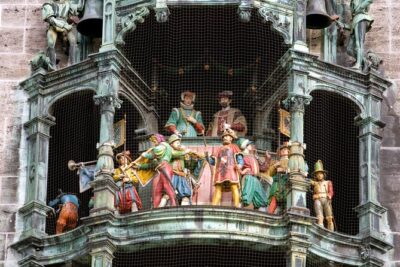
The square itself brings together the New Town Hall, Old Town Hall, and the famous Glockenspiel. The mechanical clock reenacts two important scenes from Munich’s past while a carillon plays. Victoria explains what you are seeing rather than leaving you to watch a moving façade without context.
The tour ends here, not back at Isartor. That is convenient because Marienplatz is the heart of the old town and a natural place to continue on your own. Victoria’s suggestions can help you choose a nearby restaurant, coffee stop, beer hall, museum, or additional sight.
What the private format adds
A private tour for up to six people costs $157.28 per group. For six people, that works out to about $26 per person. For two people, it is about $78.64 each, so the value depends heavily on group size.
The advantage is not just privacy. You can ask questions without waiting for a large group, and Victoria can adjust the pace. She has accommodated families with a six-month-old baby and grandparents, and she has shifted start times when travel delays caused problems.
The private format also makes this a sensible choice for families with teenagers. Victoria uses images and maps on an iPad, and the tour mixes politics, medieval stories, food, beer, architecture, and odd local customs. That variety helps prevent a two-hour history walk from feeling like a classroom.
The tradeoff is that you pay more than you would for a large group walking tour if only one or two people book. You are paying for flexibility and personal attention, not for included meals or major paid attractions.
How the pace and guide style work
Victoria’s strongest feature is her presentation. She speaks fluent English, uses visual material when helpful, and balances dates with stories. Her background in medieval history and architecture gives her a solid base, but the route is not presented as a lecture.
The pace is designed to cover a lot without making you sprint. Stops range from five to 20 minutes, and there is enough variety to hold the attention of children and teenagers. A bathroom break can be arranged during the walk, which is a practical touch for families.
You should also expect the guide to take questions seriously. The experience includes advice on restaurants, coffee, beer, shopping, museums, and later sightseeing. If you arrive with a short list of interests, this private format gives you a good chance to shape the conversation.
Who will get the most from this walk
I would choose this tour if you have only a day or two in Munich and want to get your bearings fast. The route covers the main old town sights while adding the stories that make them easier to remember.
It also suits you if you like history but do not want a tour limited to famous buildings. The walk connects medieval trade, royal rule, food traditions, beer culture, local legends, the Nazi period, and modern city life.
Families are a strong match. The flexible pace, visual aids, range of subjects, and manageable two-hour length work well for mixed ages. It is also a good fit for first-time visitors who want practical advice before choosing where to eat or what to visit next.
You may want a different experience if you prefer long interior visits, extensive museum time, or a tour focused almost entirely on World War II. This walk gives you a broad introduction, not a specialist study.
Practical details that affect your choice
The tour lasts about two hours and is offered in English. It uses a mobile ticket, begins at Isartor, and ends at Marienplatz. All listed stops are free to enter, and there are no food or drinks included.
Most people can take part, and service animals are allowed. The route is near public transportation, which makes both the starting point and the end of the walk practical for a day of sightseeing.
The experience is popular enough that it is booked an average of 71 days ahead. If your schedule is fixed, especially for a small group, booking early is sensible.
Free cancellation is available up to 24 hours before the start time. Changes or cancellations made less than 24 hours before the start are not accepted for a refund.
Should you book this Munich walking tour?
Book it if you want a personal introduction to Munich that mixes major sights with memorable local stories. Victoria’s route gives you a useful first map of the old town, while her recommendations can shape the rest of your visit.
The best value comes with four to six people, when the group price becomes quite reasonable. Couples should book if they place a high value on private attention, flexible pacing, and direct advice. Skip it if your priority is a long museum visit or a paid attraction with extensive time inside.
For a first morning or afternoon in Munich, this is a smart way to connect the city’s grand buildings with its food, politics, traditions, and everyday customs.
FAQ
How long does the tour last?
The walking tour lasts approximately two hours.
Where does the tour begin?
It begins under the central arch of Isartor at Isar Gate, Tal 50, 80331 Munich.
Where does the tour end?
The tour ends at Marienplatz, Munich’s central square and the heart of the old town.
How many people can join the private tour?
The price covers one private group of up to six people.
Is the tour offered in English?
Yes. The tour is offered in English, and the guide is fluent in English.
Are entrance fees included?
Yes. The listed stops have no separate admission charge, and entrance fees are included where applicable.
Are food and drinks included?
No. Food and drinks are not included in the tour price.
Is the tour suitable for families?
Yes. Most people can participate, and the guide has adjusted the pace for groups including a baby, grandparents, teenagers, and other family members.
Can I cancel for a full refund?
Yes. You can cancel at least 24 hours before the experience’s local start time for a full refund. Cancellations or changes made less than 24 hours before the start are not accepted.
Recently reviewed in Munich
- München: Vegetarische Viktualienmarkt-Probiertour Deutsch★ 4.8 · 6 reviews
- Wright Europe Vacations – Private Escorted Auto Tours★ 5.0 · 35 reviews
- Best of Munich Electric Bike Tour★ 5.0 · 38 reviews
- Munich Walking Quiz: Explore and Discover the City’s Highlights★ 5.0 · 7 reviews
- Walking Tour on Resistance to Nazism in Munich★ 5.0 · 8 reviews
- Private Transfer from Munich to Salzburg with 2 hours for sightseeing★ 4.5 · 13 reviews
- Private Transfer from Munich to Vienna with 2 hours for sightseeing★ 4.5 · 6 reviews
- 2 hour Sights Guided E-Scooter Tour in Munich★ 4.0 · 6 reviews
Munich Old Town Walking Tours, compared.
Mystic Munich – Sagas and Legends of the Old Town
Read our review →
Browse the lists this tour appears in