
Reviewed · MUNICH OLD TOWN WALKING TOURS
Mystic Munich – Sagas and Legends of the Old Town
Munich’s Old Town looks different when you hear the stories hiding behind its churches, statues, and medieval buildings. This 105-minute evening walk brings dragons, devils, saints, and mythical creatures into the streets around Marienplatz, with the city’s landmarks serving as the stage.
I like the way the tour mixes documented events with old legends, rather than treating every tale as fact. I also like the route’s concentration of sights: the Old Town Hall, Old Peter, the Frauenkirche, the Old Court, and Marienplatz all fit into one walk.
The main drawback is language: the live tour is in German only. Also, the 17:30 departure can be cold and crowded in winter, and one group of four lost sight of the guide near the end in the dark city center. Wear warm clothes and keep the guide in view.
Key points to know before booking
- Munich’s legends come alive at dusk: The timing gives the stories a fitting, slightly eerie setting.
- The route covers major Old Town sights: You pass Marienplatz, the Old Town Hall, Old Peter, the Frauenkirche, and the Old Court.
- The stories range from dragons to devils: Hear about the Lindwurm, the monsters on the Marian Column, and the devil’s role in Old Peter.
- The tour is in German: You need comfortable German skills to follow the guide’s storytelling.
- A small gift is included: It is a simple extra, but a nice touch for a themed walking tour.
- Plan for cold and crowds: Evening conditions and busy streets can affect how easily you stay with the group.
Why Munich’s Old Town makes a good setting for legends
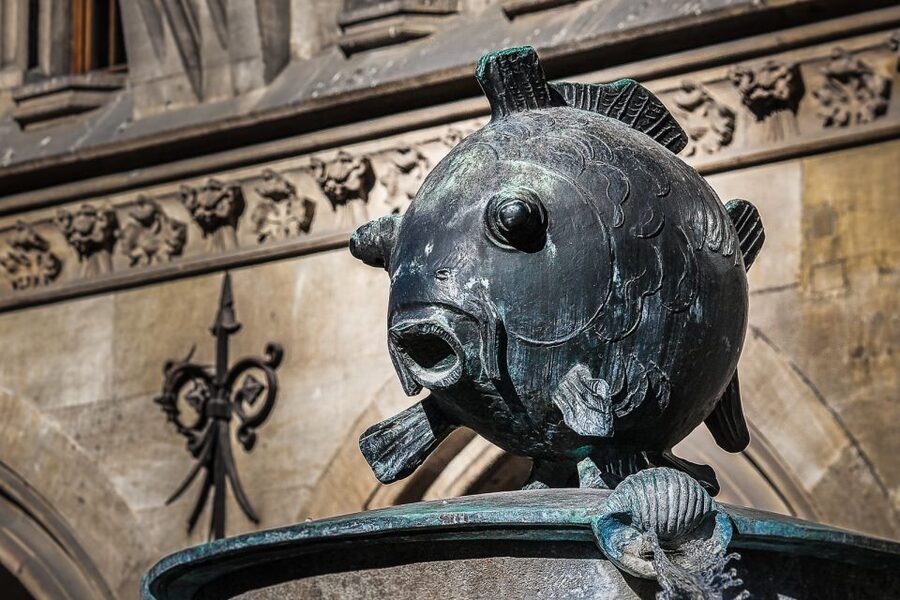
Munich’s center is compact, but its landmarks carry plenty of visual drama. Towers, saints, carved figures, old civic buildings, and church interiors give a guide something concrete to point toward while telling a tale.
That matters because this is not a ghost-story show in a theater. You move through the actual streets where Munich’s public symbols have been displayed for centuries. The setting does much of the work. A statue becomes a character, a church door becomes part of a mystery, and a familiar square takes on a second identity.
I like this approach for a first or second visit to Munich. You still see the classic sights, but you are not receiving the usual quick list of dates and architectural labels. Instead, you get the folklore that helped people explain danger, faith, power, and the strange features of their city.
The tour also keeps one foot in reality. Some stories are presented as factual history, while others belong to legend. That distinction gives the experience more value than a simple collection of spooky tales. You can enjoy the drama without having to accept every supernatural detail as truth.
More ghost and legend walks in Munich:
- Munich Ghosts and Spirits Evening Walking Tour
★ 5.0 · 1,900 reviews - Munich: Spooky Tour of Old Town in German
★ 4.6 · 1,112 reviews - Munich: Raven Black Witches and Executioners Walking Tour
★ 4.7 · 294 reviews
Meeting the mysterious side of Marienplatz
The meeting point is Marienplatz 15, in front of the entrance to the Toy Museum. Look for the entrance under the Old Town Hall, between Marienplatz and Tal. This is a useful detail because the museum entrance can be easy to miss if you are standing in the middle of the square and looking only for a large tour sign.
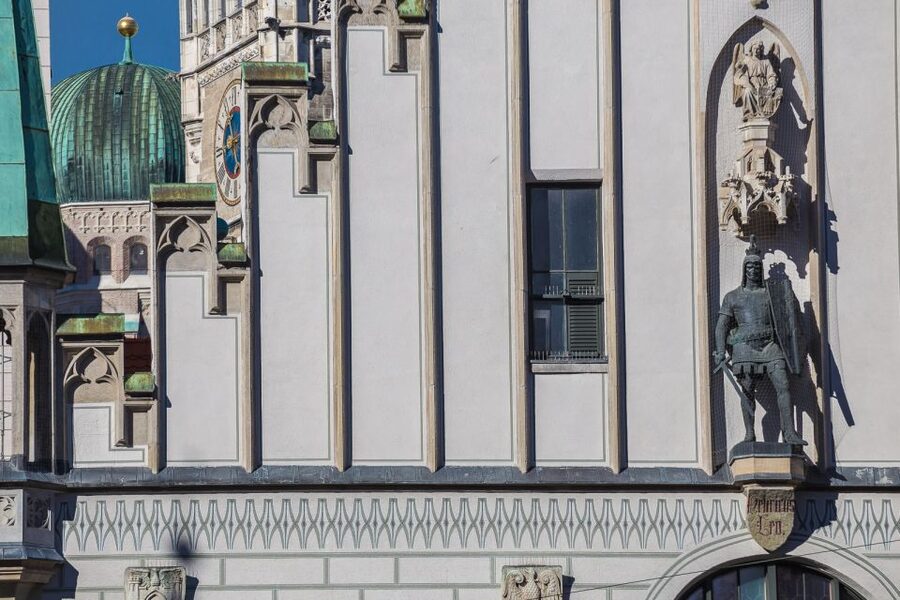
Marienplatz is the natural starting point. It is one of Munich’s best-known public spaces, so you can reach it easily while sightseeing in the center. It is also an effective opening scene: the square gathers the Old Town Hall, the New Town Hall, the Marian Column, and a steady flow of people into one place.
At the start, your guide introduces the theme of the walk and begins shifting your attention from ordinary sightseeing to the city’s darker stories. You are not simply told that a building is old or important. You are encouraged to ask what people once believed about the figures carved into it, the creatures associated with it, and the threats that supposedly shaped the city.
Because the tour operates in the evening, the light can add to the mood. The later departure reviewed at 17:30 was enjoyable despite winter cold, but darkness also made it harder for a small group to keep sight of the guide near the finish. Stay close, especially when crossing busy areas.
The Lindwurm and the New Town Hall
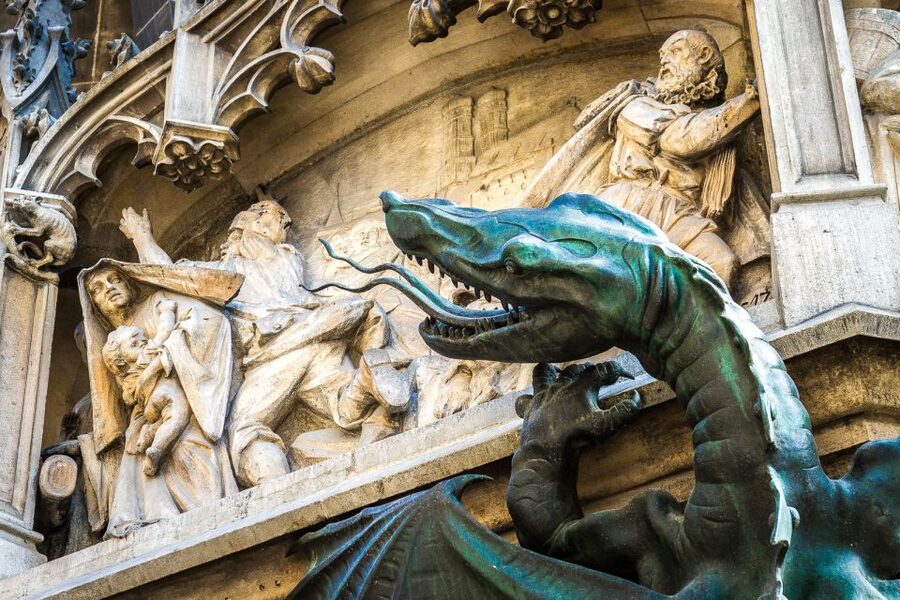
One of the tour’s featured stories concerns the Lindwurm at the New Town Hall. The Lindwurm is a dragon-like creature, and its presence gives the building a distinctly mythical side.
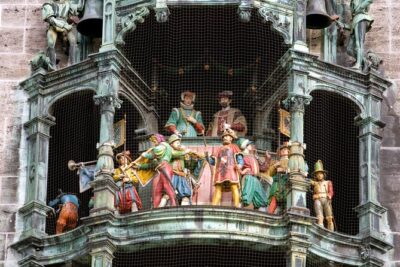
The New Town Hall is already one of Munich’s most photographed sights, but a legend-based explanation changes how you look at it. Instead of focusing only on the façade or the famous clock, you listen for the creature and the meaning attached to it.
This is a good example of the tour’s method. A major landmark becomes a clue. The guide explains the story, then helps you connect the tale to the physical details around you. I find that useful because it gives you something to remember after the walk. You may forget a building date, but a dragon tied to Munich’s civic center is harder to lose.
The exact balance between legend and documented fact is part of the appeal. You hear the story, then learn what lies behind it. That keeps the tour from becoming pure fantasy and gives German-speaking visitors a better sense of how local tradition and city history overlap.
The Marian Column and its battling monsters
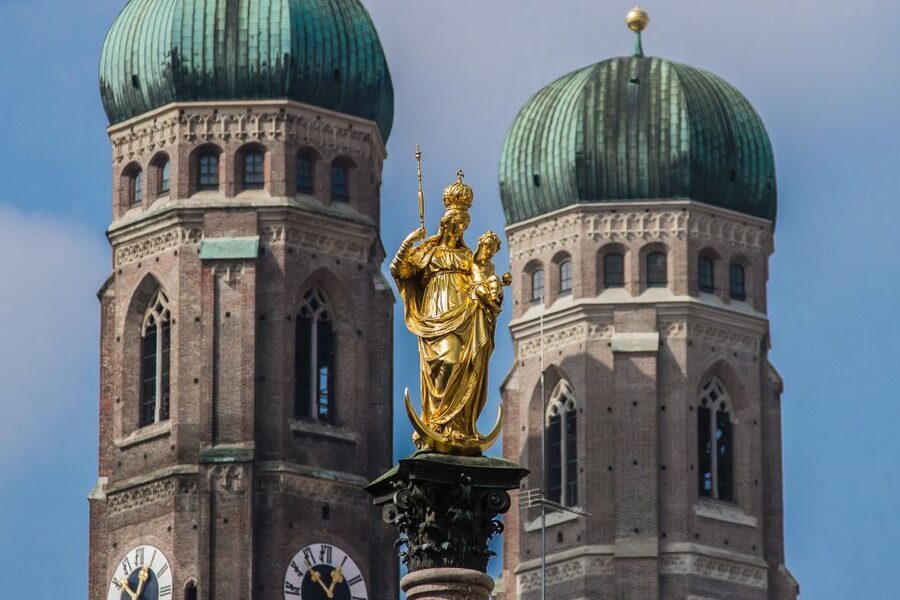
The Marian Column is another important stop. The column includes figures connected with monsters, and the tour explains the role of the hero Putti, who fought them.
This scene brings a little action to the walk. You are not just looking at a religious monument as a piece of public art. You are hearing about conflict, protection, and the symbolic enemies associated with Munich.
The stop should work well for families with older children, since the idea of small heroic figures battling monsters is easy to picture. It also gives adults a useful key for reading the monument. Religious statues and columns often look like decoration when you pass them quickly. A story gives the carved figures a purpose.
I would pay close attention to the guide’s explanation here, since this is one of the points where the tour connects a visible landmark with a larger set of beliefs. The experience is most rewarding when you look at the monument while the story is being told, rather than treating the stop as a quick pause for photographs.
More walks through the old town:
- Munich: Old Town & Viktualienmarkt City Walk in German
★ 4.7 · 2,304 reviews - Munich Old Town Walking Tour
★ 4.5 · 1,287 reviews - Munich: Walking Tour Old Town and Viktualienmarkt
★ 4.7 · 839 reviews - Munich: Old Town Walking Tour
★ 4.7 · 589 reviews
Old Peter and the devil’s plan
The church known as Old Peter provides one of the tour’s more striking legends. You hear how the devil was supposedly stopped from destroying the church.
This tale gives the church a darker edge, but the value is not only the supernatural plot. The story shows how people used legends to explain danger around a major religious building. A church was not just a place of worship. In local imagination, it could also be a target in a cosmic struggle.
The tour also asks you to look St. Onuphrius straight in the eye. That is a wonderfully specific instruction, and it turns the visit into an act of observation. Rather than walking past another saint’s image, you are given a detail to find and a reason to examine it.
Old Peter is one of the places where you should resist rushing ahead. Listen first, then look closely at the feature the guide names. The stories depend on seeing the object in front of you, and the experience loses some of its force if you are busy photographing everything at once.
The Old Court and the Frauenkirche
The route also takes in the Old Court and the Frauenkirche. These are familiar Munich sights, but the legends provide a different entry point than a standard architectural tour.
At the Old Court, the focus is on the older and more mysterious side of the city center. The name itself suggests an earlier Munich, before the modern city spread outward. This is where a guide’s storytelling can help you picture the people and fears connected with the place.
The Frauenkirche adds another major religious landmark to the route. You will see it as part of the city’s legendary world rather than only as a famous church with twin towers. The tour’s questions about saints, devils, and protection fit naturally with a building that has long shaped Munich’s skyline.
The precise amount of time spent at each site can vary with the guide and the group. That is normal on a walking tour built around storytelling. You should expect a guided route through the Old Town, not a full interior visit or a detailed architectural lecture at every stop.
What the storytelling style is like
The strongest part of this experience is the storytelling. The German-language guide needs to do more than recite facts, since the tour depends on suspense, timing, and a clear explanation of what is real and what belongs to legend.
Patricia led one highly praised tour and was described as making the afternoon vivid, engaging, and full of joy. Another guide might have a different style, but Patricia’s example gives you a sense of the tone to expect: animated storytelling rather than a dry list of monuments.
The tour has also been described as combining factual historical material with legendary stories. That mixture is important. If you want only verified dates and architectural terms, a standard city tour may suit you better. If you like asking why a statue looks the way it does, or how a local tale began, this format offers more personality.
The tour is designed for a broad age range. Families, adults, Munich residents, and first-time visitors can all find an entry point. You do not need to know Munich’s history in advance, but you should be comfortable listening to German for nearly two hours.
Timing, group size, and winter conditions
The advertised duration is about 105 minutes, or one hour and 45 minutes. That is long enough to cover several central landmarks without taking up your entire evening.
The tour operates at dusk or into the evening, which suits the subject. Shadows and fading light can make the legends feel more atmospheric, but the same conditions create practical issues. Winter temperatures in Munich can be unpleasant when you are standing still while a story is told.
Dress for the weather, even if your daytime plans have been indoors. Comfortable shoes are also sensible because this is a walking tour through the Old Town. The available information does not specify a maximum group size, and one winter departure had a fairly large group.
A larger group can make it harder to hear or stay close on crowded streets. Keep the guide visible, especially near the end. The city center can become confusing after dark, and a guide wearing a bright color or carrying a clear marker would help, but you should not assume one will be provided.
The tour is wheelchair accessible. The supplied details do not describe the exact surfaces, route changes, or toilet access, so you may want to confirm those points if you need specific mobility information.
Is $26 a fair price?
At $26 per person, the tour is priced like a focused themed walking experience rather than a full-day city tour. I consider that reasonable if you want both sightseeing and entertainment in one short evening activity.
The value comes from the interpretation. You can walk through Marienplatz and past the Old Town Hall on your own for free, but you will not automatically know the Lindwurm story, the legend of Old Peter, the meaning attached to the monsters on the Marian Column, or why St. Onuphrius deserves a direct look.
The price also includes a small gift. That will not determine the decision by itself, but it adds a pleasant finish to the experience.
I would not choose this as your only Munich tour if you need a broad introduction to Bavarian politics, art, food, or architecture. It is narrower by design. You pay for a particular angle on the Old Town, and the tour works best when that angle appeals to you.
Free cancellation up to 24 hours before the start gives you some flexibility, and you can reserve now and pay later. Those options matter if your Munich schedule is still moving around, especially during a short city break.
Who should book this Munich legends tour?
I would recommend it to German-speaking visitors who have already seen the basic sights and want a more unusual way to read them. It is also a good choice for Munich residents who think they know the center but have not heard its local legends.
Families with children may enjoy the monsters, dragons, heroes, and devils, though the guide’s German delivery and the evening timing are important considerations. The subject is spooky in places, but the information provided does not describe it as a horror attraction.
Choose another kind of tour if you want a silent nighttime walk, a ghost investigation, or a full interior visit to the churches. This is a live storytelling walk through public Old Town spaces.
Final verdict: a smart second look at Munich
Book Mystic Munich if you want the Old Town to feel less familiar and more mysterious. The route covers major sights, but the stories give you a reason to stop and look again at details most people pass without noticing.
I especially like the mix of fact and folklore, the dusk timing, and the strong focus on specific objects such as the Lindwurm, the Marian Column’s monsters, and St. Onuphrius. Just remember that the tour is in German, winter evenings can be cold, and you need to stay close to the guide in crowded streets.
For $26, it is a fair-value choice for curious visitors who prefer local tales to a standard monument checklist. If dragons, devils, saints, and old city mysteries sound more appealing than another basic walking tour, this is a good way to spend 105 minutes in Munich.
FAQ
How long does the Mystic Munich tour last?
The tour lasts approximately 105 minutes, or one hour and 45 minutes.
What language is the tour in?
The live tour is conducted in German. German is the only listed tour language.
Where does the tour meet?
The meeting point is Marienplatz 15, in front of the Toy Museum entrance. The entrance is under the Old Town Hall, between Marienplatz and Tal.
Which Munich sights are included?
The route includes Marienplatz, the Old Town Hall, Old Peter, the Old Court, and the Frauenkirche. It also features the New Town Hall and the Marian Column through stories connected with their legends.
Is the tour wheelchair accessible?
Yes, the activity is listed as wheelchair accessible.
Can I cancel the booking?
You can cancel up to 24 hours before the tour for a full refund. You can also reserve now and pay later.
Recently reviewed in Munich
- München: Vegetarische Viktualienmarkt-Probiertour Deutsch★ 4.8 · 6 reviews
- Wright Europe Vacations – Private Escorted Auto Tours★ 5.0 · 35 reviews
- Best of Munich Electric Bike Tour★ 5.0 · 38 reviews
- Munich Walking Quiz: Explore and Discover the City’s Highlights★ 5.0 · 7 reviews
- Walking Tour on Resistance to Nazism in Munich★ 5.0 · 8 reviews
- Private Transfer from Munich to Salzburg with 2 hours for sightseeing★ 4.5 · 13 reviews
- Private Transfer from Munich to Vienna with 2 hours for sightseeing★ 4.5 · 6 reviews
- 2 hour Sights Guided E-Scooter Tour in Munich★ 4.0 · 6 reviews
Munich Old Town Walking Tours, compared.

Fall in Love with Munich in a Private Old Town Walking Tour
Read our review →
Browse the lists this tour appears in